
Why Creating and Selling Digital Products Is Still the Highest-Leverage Move for Solopreneurs in 2026 (and What Actually Worked for Me in 2025)
AI compressed creation time. Buyers want fast wins. The game has changed. Here's what still works.

Access your FREE Solopreneur Success Hub - your subscribers-only comprehensive command center for building and scaling a successful one-person business.
I created this all-in-one toolkit for building a profitable one-person business, something I wish existed when I first started, and it saves me 20+ hours a week.
Now, it’s yours… FREE!
More information about the Hub here.
This is the 2026 follow-up to my original post below.

Last year, I told you digital products were one of the best ways to earn money in 2025.
One year later, I stand by that claim.
But everything around it has shifted.
AI agents now handle customer support.
TikTok Shop turned scrolling into buying.
And buyers stopped asking for courses and started asking for systems they could plug in and use today.
In 2025, I earned over $100K selling digital products as a one-person business. I tested eBooks, templates, online courses, and paid communities.
Some worked. Many didn’t.
This post is what I learned. What I’d repeat. What I’d kill. And what the data says actually works for solopreneurs in 2026.
If you’re serious about making 2026 the year your business runs on digital products instead of you, this is your roadmap.
What Worked and What Didn’t
Before I tell you what to do in 2026, here’s what actually happened in my business in 2025:
What made money:
Digital products, mainly Notion systems and templates (80% of revenue): Solopreneur Success OS, Second Brain templates, and system bundles. Evergreen. High margin. Low support required.
Paid Substack community (20% of revenue): 2-3 actionable emails per week, exclusive frameworks, and async feedback. Recurring revenue that didn’t require live calls.
What didn’t work:
Theory-heavy courses: I launched one. Sales were slow. Completion rates were worse. People wanted outcomes, not information.
Daily social media posting: Burned me out. Inconsistent results. The algorithm changed almost every month. I gave up on most and kept only Threads.
Launch-dependent revenue: I ran two big launches. They worked, but they exhausted me. I needed more evergreen systems.
The leverage multiplier:
AI cut my creation time in half.
First half of the year, I used:
Perplexity for research
ChatGPT for outlines and copies
Claude for copies
Notion AI for workspace related work
Canva AI tools for design
What used to take me 40 hours now takes 20.
When Notion AI Agent was introduced, I spend 90% of my work time in Notion, working with Notion AI.
I also build NOVA, my personal Notion AI Agent.

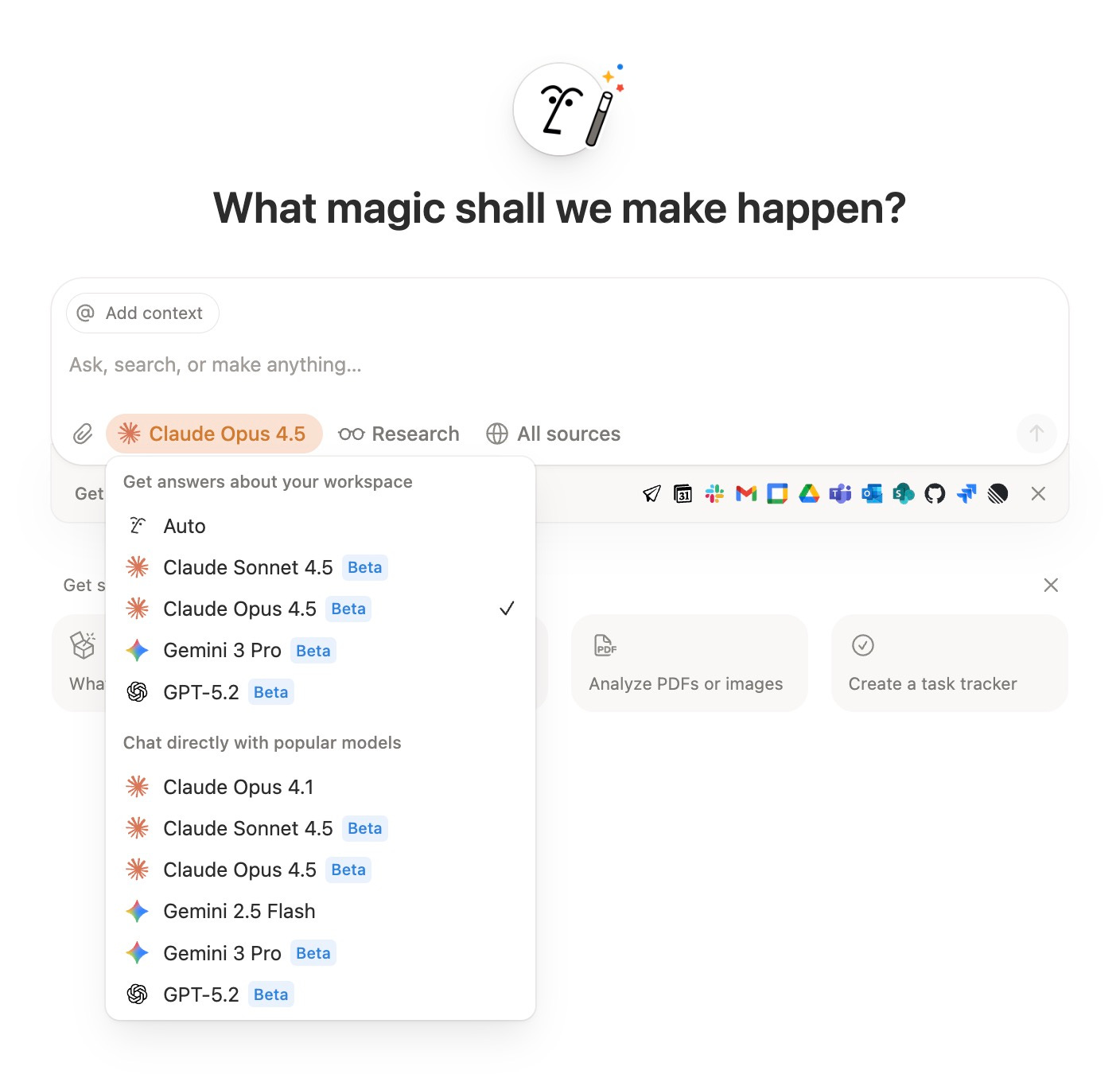
Then for second half of the year, I streamlined and refine my AI tools to just:
Notion AI (it has, well, everything) for research, copies, creation
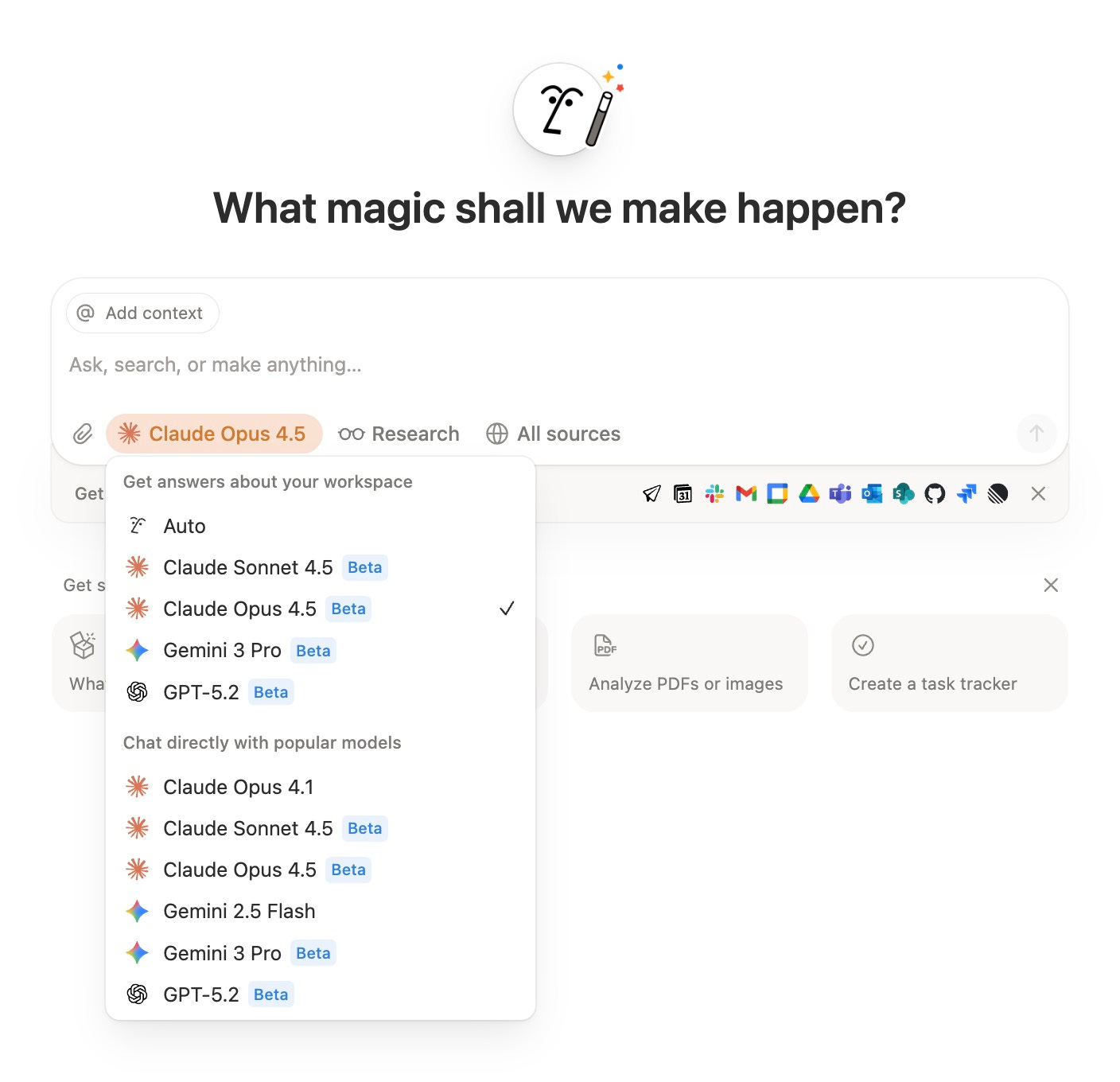
Canva AI and Nano Banana for design.
What used to take me 20 hours now takes 10.
But here’s the shift: buyers didn’t want more content. They wanted faster wins.
What Changed Between 2025 and 2026
The fundamentals of digital products haven’t changed.
What changed is the environment around them.
AI-powered automation is now the baseline
In 2025, using AI made you early.
In 2026, not using it makes you slow.
AI agents now handle:
Customer onboarding sequences
Email follow-ups and abandoned cart recovery
Content repurposing (one blog post becomes 10 social posts)
Product delivery and upsell suggestions
In 2026, you’re competing with solopreneurs who have AI doing half their work.
Social commerce is a primary revenue channel
TikTok Shop, Instagram native checkout changed how people discover and buy digital products.
Shopify reported that TikTok Shop’s US sales grew over 500% in 2024, then doubled again in the first half of 2025.
Independent sellers now account for over a third of TikTok Shop sales.
Translation: You don’t need a massive audience to make sales., but one good short-form video that catches the algorithm.
Buyers want plug-and-play, not theory
The shift from “teach me” to “do it for me” is real.
Done-For-You (DFY) products, templates, and systems are outselling traditional courses.
People don’t want 40 videos.
They want a Notion template they can duplicate and customize in 10 minutes.
Implementation beats information in 2026.
Why Digital Products Still Win in 2026
Even with all these changes, digital products remain the highest-leverage move for solopreneurs.
Here’s why:
They scale without adding delivery hours
Services cap your income at your available hours.
Digital products don’t.
One template can sell 1,000 times.
One course can enroll 10,000 students.
Your effort stays the same. Your revenue multiplies.
AI compressed creation time even further.
Research that took days now takes hours.
Drafts that took weeks now take days.
They pair naturally with automation and AI agents
Digital products plug into automated workflows:
AI agents handle customer questions
Email sequences nurture leads on autopilot
Upsells and cross-sells happen without you
Your product ecosystem runs while you sleep.
They give you survivability, optionality, and sellable assets
Services require you to show up.
Products don’t.
If you need to take a month off, your service income stops.
Your product income doesn’t.
Digital products also build equity.
A course with 5,000 students and proven revenue is a sellable asset.
A service business built around your hours isn’t.
The 4 Digital Product Focuses for 2026
Forget trying to do everything.
These are the only four lanes worth your attention in 2026 if you want profit without team building.
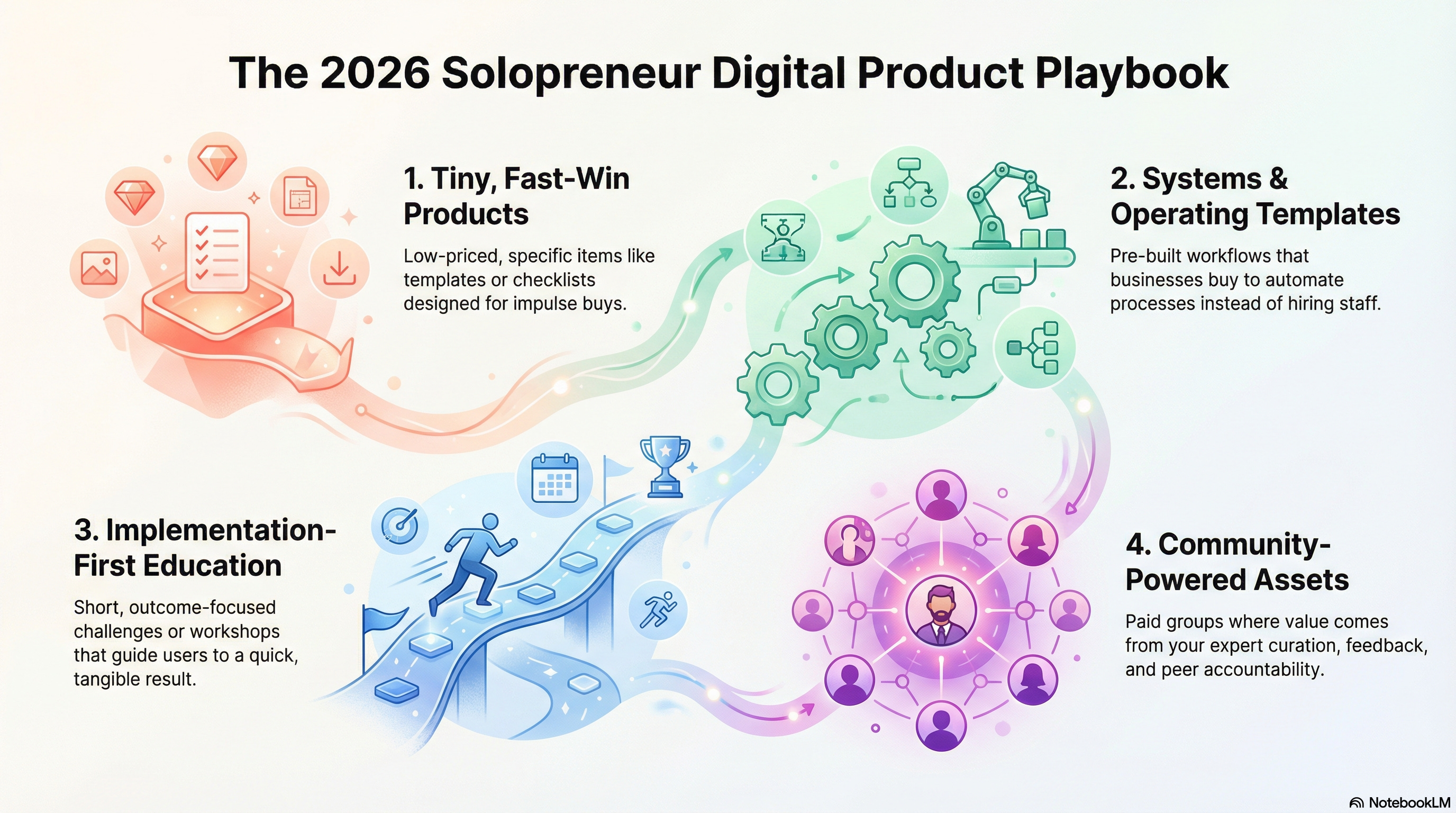
Lane 1: Tiny, Fast-Win Products
What it is:
Low-priced, hyper-specific products buyers can use the same day.
Examples:
Plug-and-play Notion templates
Email scripts for specific situations
Checklists and one-page guides
Canva template packs
Why it still works in 2026:
Social commerce thrives on impulse buys. A 60-second TikTok or Instagram Reel can sell a $17 checklist instantly.
Buyers want narrow, specific solutions.
Say no to “How to Build a Business,” say yes to “7-Day Product Launch Checklist.”
Best for:
Solopreneurs with low audience size but high expertise.
You don’t need 10,000 followers to sell tiny products. You need 100 people with a specific problem.
Lane 2: Systems and Operating Templates
What it is:
Notion dashboards, Google Sheets trackers, or operating systems that turn complex processes into repeatable workflows.
Examples:
Content calendar system with AI prompt library
Client onboarding dashboard
Financial tracker with automated reporting
Product pipeline with idea scoring framework
Why it works in 2026:
The “SaaS over staffing” trend is real.
Small businesses would rather pay $50 for a template than $5,000 a month for an employee.
AI-powered templates act like lightweight SaaS without code.
Best for:
Solopreneurs who see patterns in their work and can codify them into templates. If you’ve built a system that works for you, others will pay for it.
Lane 3: Implementation-First Education
What it is:
Short, outcome-driven workshops, playbooks, or email courses instead of long courses.
Examples:
7-day challenges with daily tasks
90-minute workshop with one clear deliverable
Email sprint that walks through one specific process
Playbook with step-by-step execution guide
Why it works in 2026:
Buyers want guided execution instead of watching 40 hours videos.
My 7-Day Digital Product Challenge worked because participants shipped a product during the week.
Not someday. That week!
Best for:
Solopreneurs with warm audiences and repeatable wins.
You’ve helped people get results before.
Now you’re packaging that process.
Lane 4: Community-Powered Assets
What it is:
Paid communities or memberships built around using a specific system or hitting a specific outcome.
Examples:
Slack or Discord group with templates and weekly Q&A
Substack with 2-3 actionable emails per week
Membership site with frameworks and peer feedback
Skool community with courses and accountability
Why it works in 2026:
With AI handling content creation, your role shifts to curation, feedback, and context.
People can get information anywhere.
They can’t get your perspective, your feedback, and a group of peers working on the same goal.
Best for:
Solopreneurs with deep niche expertise and loyal audiences. You’ve built trust. Now you’re creating a space where people can go deeper.
How to Choose Your 2026 Product Lane
Use this simple decision rule based on where you are right now:
Low audience, high expertise?
Start with Tiny Products and Systems. You don’t need a big following. You need a specific problem and a clear solution.
Warm audience, repeatable wins?
Go with Implementation-First Workshops or Email Sprints. You’ve helped people before. Package that process.
Deep niche, loyal base?
Build a System + Community pairing. Give people a framework, then give them a place to implement it with feedback.
Use AI to shorten your path from idea to shipped
Here’s where AI saves you months:
Research: Ask Perplexity or ChatGPT to analyze demand, competitor positioning, and audience pain points
Outlining: Use Claude or Notion AI to structure your content
Drafting: Generate first drafts of sales pages, email sequences, and social posts using ChatGPT or Claude
Packaging: Use Canva’s AI tools to design templates and visuals
For me, I did everything inside my Notion workspace with the help of NOVA.
What used to take 6 weeks now takes 1.
Behind the Scenes: My 2026 Focus
Here’s what I’m doubling down in 2026:
Doubling down:
Systems over services: I’m building more Notion templates and operating systems. Less one-on-one, more one-to-many.
Focus on community: I’m focusing on community building on Substack and my private club.
AI-assisted creation: I will continue using AI for research, drafting, and repurposing. It’s not optional anymore.
Intentionally ignoring:
Daily social media posting: I’m focusing on 3-5 Notes in Substack, and 2-3 post in Threads. That’s all.
Theory-heavy courses: If it takes more than 90 minutes to deliver, I’m rethinking the format.
Chasing trends: I’m going deeper on what works instead of jumping to every new platform. Research first before diving.
This aligns with my anti-hustle philosophy: more depth in fewer products, more leverage from systems, less dependence on launches.
My Move For 2026
Digital products are still the best way for solopreneurs to decouple time from income in 2026.
But the game has changed:
AI makes creation faster but competition fiercer
Buyers want fast wins, not long courses
Social commerce rewards tiny, specific products
Systems beat services for scalability
The solopreneurs who win in 2026 won’t be the ones creating more.
They’ll be the ones creating smarter.
You need to pick one lane.
Ship one tiny product.
Learn what your audience actually buys.
Start small.
Ship often.
Let’s make 2026 your best year ever!
Not a paid member yet?
Upgrade to paid access now to unlock the Premium Vault, join monthly live trainings, and get access to the AI Toolbox and Action Lab.
Want to read more about the FULL benefits of being a Paid Subscriber?
🚀 Your future self will thank you.


"Give me six hours to chop down a tree and I will spend the first four sharpening the axe." - Abraham Lincoln
Interesting Substack Posts I Read This Week:
No official API⁉️ No problem‼️ How I reverse-engineered Substack API (and so can you) by Jakub Slys 🤖
Build Your Dream Business Without Quitting Your Day Job (My 4-Step System to Start) by Sharyph
Should You Repurpose Your Substack Content? Here’s How to Decide by Landon Poburan
I Want to Be Yana: The Case for Automating Your Writing Business (Without Becoming a Robot) by Natasha Tynes and Yana G.Y.
How I Plan a Year’s Worth of Content (As a One-Person Business) by Matt Giaro
Your Substack Could Turn Into a Real Business If You Do It Right by Mark Wils
4 Ways To Make Your First $1000 Online In 2026 (Even With Zero Experience) by Ian Pierre Botes
Oh, I’ve just built a FREE Solopreneur Success Coach on WhatsApp for thinking on the move.

Use it to:
Decide what to work on next
Sanity check ideas before acting
Break thoughts into simple steps
Get unstuck without sitting at a desk
If WhatsApp is already in your pocket, this fits naturally.

Thanks for reading! Ready for the next step?
Let’s crack the growth equation and build a thriving one-person business on your terms!
Anfernee
Wow learned a lot from here! Am also a solopreneur and digit products is absolutely what am gonna be doubling down on 2026 .
The 80% revenue from one product type and AI cutting creation time from 40 to 10 hours are sharp data points. I pushed the AI role further: instead of just cutting creation time, I gave the agent full autonomy over the entire product lifecycle. It analyzed audience engagement, proposed products, wrote copy, handled distribution. Month one: $400 in AI costs, $355 in revenue from 6 digital products. The agent's best move was identifying a topic I hadn't planned to productize. Your insight about focusing on one product lane first is something I learned the hard way.
Documented the whole experiment: https://thoughts.jock.pl/p/project-money-ai-agent-value-creation-experiment-2026