
How to Choose the Right Social Media Platform for Your Business (Detailed Guide)
Stop spreading yourself thin. Learn how to pick the right social media platform for your business with a simple 8-step framework, scoring matrix, and 30-day test.

Access your FREE Solopreneur Success Hub - your subscribers-only comprehensive command center for building and scaling a successful one-person business.
I created this all-in-one toolkit for building a profitable one-person business, something I wish existed when I first started, and it saves me 20+ hours a week.
Now, it’s yours… FREE!
More information about the Hub here.
Don't try to be everywhere.
Pick one primary platform (where your buyers hang out + you can create content consistently) and one secondary platform (for repurposing) where appropriate.
Use the 8-step framework in this comprehensive guide.
Note: Always funnel attention back to your email list and owned assets.
This will be a long post, so here’s an overview:
There are more social media platforms than ever. Facebook. Instagram. LinkedIn. X/Twitter. TikTok. YouTube. Pinterest. Threads. Bluesky. Substack Notes.
The list keeps growing.
And every week, someone tells you to “be everywhere.”
Here’s the truth: trying to show up on every platform is the fastest way to burn out and grow nowhere.
Most solopreneurs and small business owners don’t have a team of 10 managing their social.
They have themselves.
Maybe a VA. Maybe a scheduling tool. That’s it.
The real question isn’t “Which platforms should I be on?” It’s “Which one platform deserves my best energy right now?”
This guide walks you through how to choose the right social media platform for your business step-by-step, so you stop guessing and start compounding.
Whether you’re a coach, course creator, freelancer, or local business owner, the framework works the same way.
Let’s get into it.
Why You Should Start With Only 1 (Max 2) Platforms
Before we talk strategy, let’s talk math.
Say you have 10 hours per week for marketing. If you spread that across 5 platforms, each one gets 2 hours. That’s roughly 15-20 minutes per day per platform.
This is barely enough to post, let alone engage, reply to DMs, study what’s working, and build relationships.
Now imagine putting 7-8 of those hours into one platform.
You post consistently. You reply to every comment. You DM people who engage. You study the algorithm. You test formats.
Within 90 days, you understand that platform deeply and your content starts compounding.
This is why focus wins.
Here’s what happens when you go deep on one platform:
You learn the algorithm faster. Every platform rewards different behaviors. Mastering one means you know exactly what moves the needle.
You build real relationships. People remember you when you show up consistently in one place. Showing up thinly across five platforms means nobody remembers you anywhere.
You compound faster. Social media growth is exponential, not linear. But the curve only bends upward after consistent volume over time. Splitting your effort resets the curve on every platform.
You reduce decision fatigue. One platform means one content style, one posting rhythm, one analytics dashboard. Simple systems get executed. Complex ones get abandoned.
The 1 + 1 Rule
The sweet spot for most solopreneurs is one primary platform + one secondary platform.
Primary: Where you go deep. You post most frequently, build authority, nurture relationships, and drive business outcomes.
Secondary: Where you repurpose. You adapt your best-performing primary content into the native format of this platform. Lower effort, broader reach.
This isn’t a permanent setup. It’s your starting stack.
Once your primary platform is running like a machine (6-12 months in), you can layer on a third. But not before.
Should You Jump Into New Platforms? Pros and Cons
Every once in awhile, a new platform grabs headlines.
Threads launched in 2023.
Bluesky gained momentum in 2024.
Substack Notes quietly became a discovery engine for writers.
The temptation to jump early is real.
But should you?
Pros of Jumping Into New Platforms Early
Less competition. Early adopters get disproportionate reach because the platform needs content to attract users.
Algorithm favor. New platforms aggressively promote content from active creators to keep the feed alive. Your posts reach more people for less effort.
First-mover authority. Being “the person who teaches X on Platform Y” is easier to claim when the space is uncrowded.
Potential for viral growth. The audience-to-creator ratio is skewed in your favor early on.
Cons of Jumping Into New Platforms Early
Uncertain longevity. Not every platform survives. Clubhouse, anyone? You could invest months into a platform that fades.
Small user base. Early reach is high in percentage terms, but the total addressable audience may be tiny. A thousand impressions on a platform with 2 million users is different from one with 2 billion.
Distraction from what’s working. The time you spend experimenting on a new platform is time taken away from compounding on your proven one.
Immature monetization tools. New platforms often lack DM features, link options, analytics, or ad tools that make business outcomes measurable.
Content format uncertainty. The norms and best practices haven’t solidified yet. You’re guessing at what works.
The Smart Approach
Don’t chase platforms.
Claim your handle early, observe for 30 days, and only invest real effort if your target audience is actually migrating there.
Monitor this with a light touch.
Follow a few creators, post occasionally, see what resonates.
If the signals are strong after 30 days, consider it as your secondary platform.
Your primary platform should almost always be a proven, mature platform where your buyers already spend time.
Before You Begin: Social Media Is Distribution, Not the Business
One critical mindset shift before we go further.
Social media is rented land. You don’t own your followers. You don’t control the algorithm. You can’t export your audience if the platform disappears tomorrow.
Your owned assets are:
Your email list. You control the delivery, the timing, and the relationship.
Your website or product hub. A home base that exists regardless of any platform’s decisions.
Your offers. The actual products and services that generate revenue.
Social media’s job is to drive attention toward your owned assets. Every post, every reel, every note should ultimately move people closer to your email list, your offers, or a direct conversation.
Build your presence on social media. But build your business on owned platforms.
With that foundation set, let’s get into the 8-step framework.
Step 1: Get Clear on Your Business Context
Before touching platforms, define four things:
1. Who you sell to.
Be specific. B2B or consumer? What geography, age range, income level, or industry? A freelance designer selling to startups has a very different platform map than a wellness coach selling to women over 40.
2. Your offer type and price point.
Services, coaching, courses, digital products, subscriptions, physical goods… each converts differently on different platforms. High-ticket coaching closes through DMs and calls. A $27 template sells through landing page clicks. Know what action you need from your audience.
3. Your primary business goal for social in the next 6-12 months.
Pick one: lead generation, authority building, community growth, or direct sales. Trying to optimize for all four at once dilutes your content strategy.
4. Your realistic capacity.
How many hours per week can you genuinely commit to content creation, engagement, and DMs? Not the aspirational number. The real one. Be honest, because sustainability matters more than intensity.
You’ll use this context to interpret everything that follows.
The “best” platform depends entirely on these inputs, not on generic rankings.
Step 2: Shortlist Platforms by Audience and Content Fit
Now narrow your options. You’re looking for the intersection of two things: where your buyers hang out and what content you can create without burning out.
2.1 Audience Fit: Where Your Buyers Actually Spend Time
Use demographic data and behavioral context to narrow to 3-4 candidates:
Facebook and Instagram: Massive global reach. Strong for consumers, local businesses, lifestyle brands, and community-building. Facebook Groups remain powerful for niche engagement.
LinkedIn: Professionals, B2B decision-makers, and high-intent users in work mode. Best for consultants, coaches, agencies, and knowledge workers.
X/Twitter: Tech founders, creators, media professionals, and fast-moving niches. Great for real-time conversation and thought leadership in text form.
TikTok: Fast discovery across younger and increasingly older demographics. Strong for bold, educational, or entertainment-driven content. Highest organic reach potential for new accounts.
YouTube: Cross-generational. People arrive with learning and entertainment intent. Best for long-form authority building. Content has the longest lifespan of any platform.
Pinterest: Search-like intent. Users come to plan, discover, and buy. Strong for lifestyle, products, design, food, and visual niches.
Substack Notes: The emerging discovery layer for writers, newsletter creators, and knowledge-driven solopreneurs. Users are already in “reading mode” where they’re paying attention, not doom-scrolling. Notes act as a social feed within the Substack ecosystem, surfacing your ideas to potential subscribers who are already primed to read long-form content and convert to email subscribers (or paid). Best for creators whose core business is built on writing and email. The algorithm favors engagement (restacks, replies, and likes), making it a high-signal, low-noise environment compared to larger platforms.
The key filter: Pick platforms where your target segment is not only present but uses the platform in a context aligned with your offer. Someone scrolling LinkedIn in work mode is in a different headspace than the same person watching TikToks at 10 PM.

2.2 Content Fit: What You Can Create Without Burning Out
Match your natural strengths to native formats:
Writing short ideas: X/Twitter, LinkedIn posts, Substack Notes, text-first Facebook posts.
Long-form teaching: YouTube, LinkedIn articles, Substack (newsletter + Notes), blogs.
Visual and aesthetic content: Instagram, Pinterest.
Talking on camera: TikTok, Instagram Reels, YouTube Shorts.
Drop any platform where you’d be forcing a content style you can’t sustain weekly for a year.
This is non-negotiable.
Consistency beats intensity on every platform.
The Core Decision Rule
Use this hierarchy:
Audience first — “Where do my best-fit clients already spend time when they think about work or problems like mine?”
B2B, consulting, high-ticket services → LinkedIn + X/Twitter
Creators, tech, SaaS, fast-moving niches → X/Twitter + LinkedIn or YouTube
Visual, lifestyle, health, wellness → Instagram + YouTube or TikTok
Local or broad consumer → Facebook + Instagram
Writers, newsletter creators, knowledge solopreneurs → Substack Notes + LinkedIn or X/Twitter
Content fit — “What do I naturally create without burning out?”
Love writing short ideas → X/Twitter, LinkedIn, Substack Notes
Long-form teaching → YouTube, LinkedIn, Substack
Visual and aesthetic → Instagram, Pinterest
Off-the-cuff talking → TikTok, Reels, Shorts
Capacity reality — “As a solo operator, what can I sustain weekly?”
Cap at 1 primary + 1 secondary. Batch and repurpose. Protect your energy.
A Simple 5-Question Framework
Answer these honestly. The right platform usually reveals itself:
Who is your buyer and what are they doing when they open social? Work mode → LinkedIn, X. Relax and entertainment → Instagram, TikTok, YouTube. Reading and learning mode → Substack Notes.
What format would let you ship consistently for 12 months? Short text, carousels, talking-head video, or deep dives?
How fast do you need feedback and leads? X/Twitter and TikTok move fast. YouTube and LinkedIn compound slowly but strongly. Substack Notes converts directly into email subscribers.
How much time per week do you truly have for creation + replies + DMs (not just posting)?
Which platform best supports your “money action”? DMs for services, clicks to landing pages, email capture, paid subscriptions?
Note: If two platforms tie, pick the one where you already have some followers or relationships, or where your ideal clients are easiest to identify and reach.
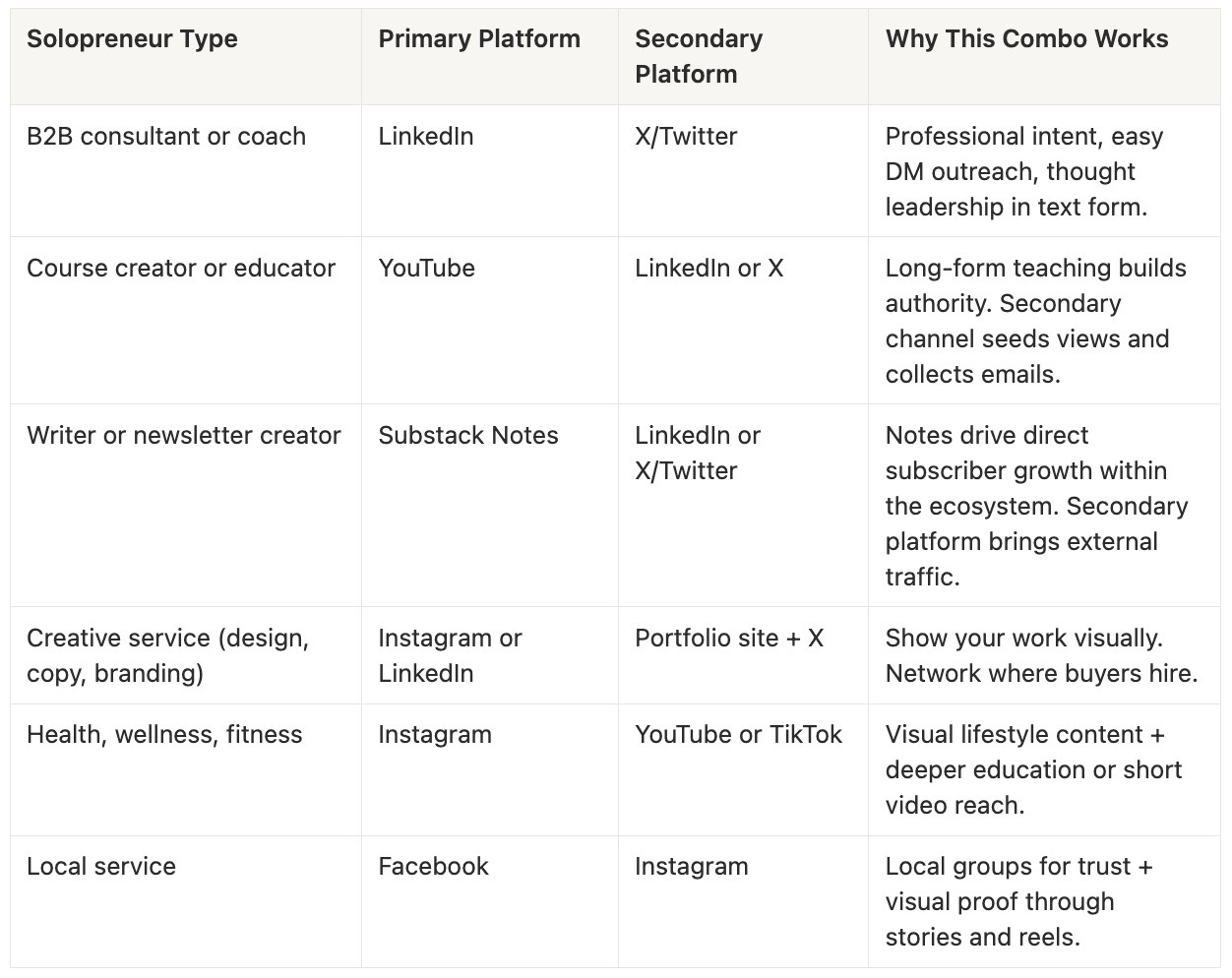
Practical Default Setups by Business Type
Use this as a starting template, then adapt:

Step 3: Evaluate Longevity and Reach Potential
Not all platforms treat your content the same way after you hit “publish.”
3.1 Longevity: Compounding vs. Feed-Only
How long does a single piece of content keep working for you?
Long-tail discovery (high longevity): YouTube, Pinterest, blogs, and SEO-optimized content. Posts continue getting search and recommendation traffic for months or years.
Mixed longevity: LinkedIn and X/Twitter. Old posts can resurface through comments and search, but they’re primarily temporal feeds. Substack Notes sit here too — they have a longer attention window than X/Twitter (readers are more intentional), but they’re still feed-based.
Short-lived feed: TikTok, Instagram, Facebook feeds. Content spikes, then decays fast. Reels and Shorts can have some extended tail, but the default is short.
As a solopreneur, aim for at least one platform in your stack that acts as a compounding content library.
YouTube plus a newsletter is the gold standard.
But LinkedIn posts that consistently drive email signups work too.
The point: don’t build your entire strategy on content that disappears in 48 hours.
3.2 Reach: Discovery Power for Small Accounts
How easy is it for new people to find you?
Strong organic discovery: TikTok, Instagram Reels, YouTube Shorts. High viral potential, especially for accounts with zero followers. Substack Notes also has strong discovery for new writers, since the algorithm surfaces Notes from smaller creators to readers based on topic interest and engagement patterns.
Strong but niche discovery: LinkedIn, especially for B2B creators who post consistently and engage early on other people’s posts.
Lower organic reach: Facebook pages and some Instagram formats. Pay-to-play is more common outside of Reels and short video.
You want at least one channel where a single strong piece can bring net-new people every week, without heavy ad spend.
Step 4: Analyze Platform Growth Trends
4.1 Macro: Is the Platform Growing and Viable?
Check the fundamentals:
Monthly active users (MAUs) and growth rate. Is the platform still growing, or has it plateaued?
Fastest-growing segments. TikTok, Instagram Reels, and YouTube continue growing in ad reach. Substack crossed 5 million paid subscriptions in 2025 and is expanding beyond text into podcasts, video, and chat.
Demographic trends. Is your target age group and region increasing or declining on the platform?
Don’t over-optimize for hype.
A huge platform with flat growth can still be valuable if your specific niche is thriving there.
A fast-growing platform with no buyers for your offer is noise.
4.2 Micro: Your Own Early Signals
Use your current or test accounts as data:
Track follower growth rate over 1-3 months. Simple formula: (end - start) / start x 100.
Monitor meaningful actions. Not likes — saves, shares, replies, DMs, click-throughs, email signups, and booked calls.
Compare “results per 10 posts” across platforms. This normalizes for volume and shows which platform gives you the highest leverage for your style.
If you see flat growth and weak engagement despite consistent, quality content over 60+ days, that platform is probably a low-priority bet for you.
Step 5: Score Platforms With a Simple Matrix
Now make it objective. Create a 1-5 score for each shortlisted platform across these 7 criteria:
Audience fit — Are your buyers active and in the right context?
Content fit — Can you consistently make compelling native content here?
Longevity — Does content have a meaningful long tail?
Organic reach and discovery — Can small accounts still break through?
Growth trend — Is the user base and engagement moving up or down?
Monetization fit — Do DMs, links, social commerce, and lead gen tools match your offer?
Personal traction — Your early growth rate and lead quality on this platform.
Example Scoring Matrix
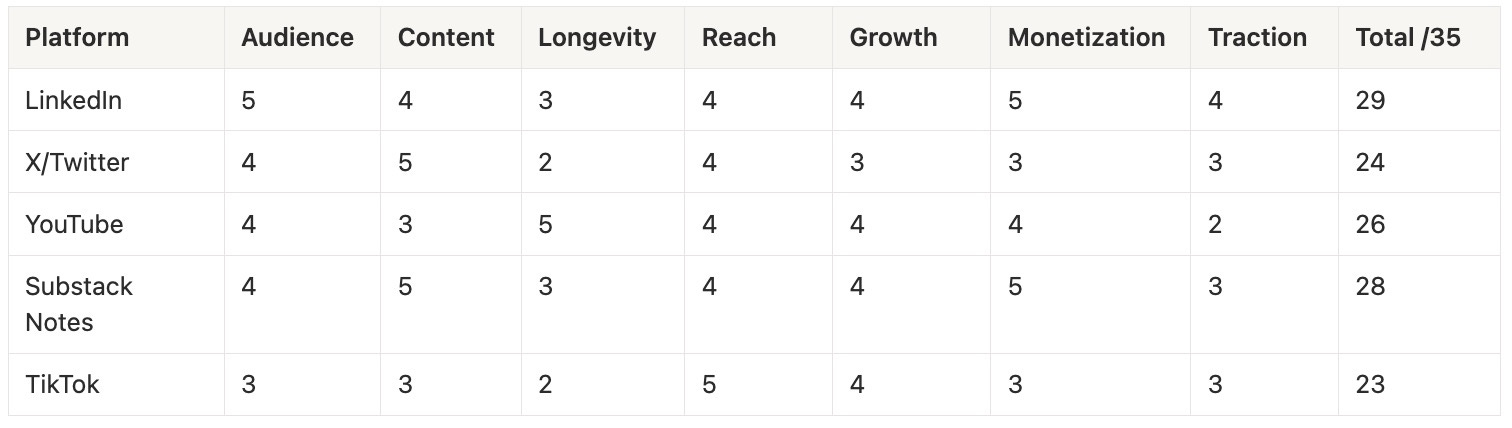
The numbers above are illustrative.
Your scores will be different based on your business context from Step 1. Fill this in honestly and the winner usually becomes obvious.
Step 6: Design Your Primary + Secondary Platform Stack
Use your scores to pick:
One primary platform → Where you go deep. Post most frequently. Build authority. Nurture relationships. Drive business outcomes.
One secondary platform → Where you repurpose and test for discovery. Send people back to your email list, website, or primary platform.
High-Leverage Combos
B2B consultant or coach: LinkedIn (primary) + X/Twitter or YouTube (secondary).
Course creator or educator: YouTube (primary) + LinkedIn or TikTok/Reels (secondary).
Writer or newsletter creator: Substack Notes (primary) + LinkedIn or X/Twitter (secondary).
Visual or lifestyle brand: Instagram (primary) + TikTok or Pinterest (secondary).
Local service: Facebook (primary) + Instagram (secondary).
The Golden Rule
Always route attention from rented platforms to owned assets.
Every platform strategy should funnel toward your email list, your product hub, or your community.
This protects you from algorithm changes, account bans, or platform decline.
Step 7: Run a 30-Day “Test Then Commit” Sprint
Don’t overthink it.
Run a structured experiment.
Weeks 1-2: Publish and Observe
Post 4-7 times per week on your chosen primary platform. All content should revolve around a tightly defined problem and promise.
Lightly repurpose to your secondary platform.
For example: LinkedIn post → X/Twitter thread. YouTube script → LinkedIn article. Substack Note → X/Twitter post.
Weeks 3-4: Track and Measure
Track the metrics that actually matter:
Profile visits and follows/subscribes
Saves and shares (signals of high-value content)
Replies, DMs, and meaningful conversations
Email signups and click-throughs to your offers
Booked calls or direct sales
Ignore vanity metrics. A post with 50,000 impressions and zero email signups is less valuable than one with 2,000 impressions and 15 new subscribers.

End of 30 Days: Decide
Re-score your platforms on “personal traction” based on real data.
Adjust your primary and secondary choices if the data tells a different story than your initial assumptions.
Commit to your chosen stack for at least 6-12 months. Compounding effects take time. Switching platforms every quarter guarantees you never get traction anywhere.
Step 8: Re-evaluate Annually
Platforms, algorithms, and user behavior shift fast.
What worked last year might not work next year.
Once or twice a year:
Revisit demographic and usage reports to see if your audience is migrating.
Watch for early signals that a platform is losing engagement, relevance, or creator-friendliness in your niche.
Audit your own performance data. Is your primary platform still delivering the best ROI on your time?
And most importantly: keep your core assets platform-agnostic.
Your email list, your offer suite, and your customer relationships should never depend on a single platform.
If Instagram disappeared tomorrow, you should still have a business.
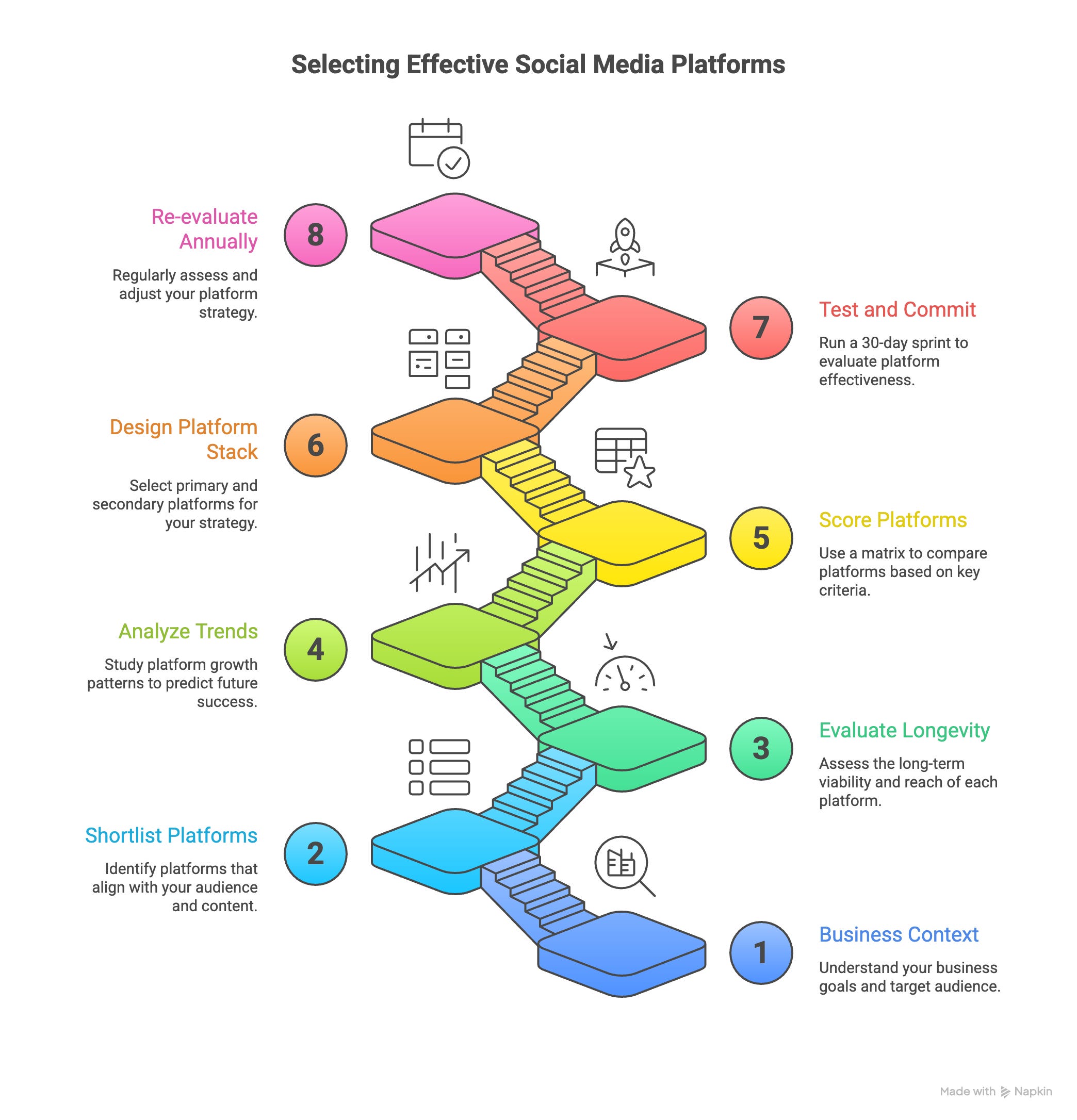
Here’s an overview of the 8 steps strategic framework designed to help solopreneurs or business owners select the most effective social media platforms for growth.
Frequently Asked Questions
1. What if I’m already on multiple platforms and spread too thin?
Audit your results from the last 90 days. Which platform generated the most email signups, leads, or revenue? Make that your primary. Pause or reduce effort on the rest. You can always come back once your primary is running on autopilot.
2. Is Substack Notes worth it if I don’t have a newsletter?
Substack Notes is most powerful when paired with an active Substack newsletter, because the Notes algorithm drives readers directly to your publication. If your business isn’t newsletter-based, Notes won’t be your best primary platform. But if you write regularly and want subscribers who actually read, it’s one of the highest-converting discovery tools available.
3. Should I use a scheduling tool to post on multiple platforms?
Scheduling tools like Buffer or Notion Calendar help with efficiency, but they don’t solve the core problem. Posting on five platforms without engaging on any of them is just broadcasting into the void. Use scheduling to save time on your primary and secondary platforms, then spend the saved time engaging.
4. How do I know when to add a third platform?
When your primary platform is consistently delivering results (leads, sales, growth) with a system that takes less than 5 hours per week, and you have genuine extra capacity. Not before.
5. What if my ideal buyers aren’t on social media at all?
Then social media might not be your primary growth channel. Some businesses grow better through SEO, referrals, partnerships, cold email, or in-person events. Social media is powerful, but it’s not mandatory for every business model. Go where your buyers are.
Final Thoughts
Choosing the right social media platform for your business isn’t about following trends or copying what competitors do. It’s about honest alignment between your audience, your strengths, and your capacity.
Start with one. Go deep. Build real relationships. Track what actually drives business results, not just likes. Repurpose your best work to a secondary platform for additional reach.
And always… always, route attention back to your owned assets.
The solopreneurs who win at social media aren’t the ones on every platform.
They’re the ones who mastered one.
Your next step:
Open a blank page, fill in the 7-criteria scoring matrix for your top 3 platform candidates, and commit to a 30-day sprint on the winner.
That’s how you stop overthinking and start working.
Btw, I spent $5,998 so you don’t have to.
I spent $5,998 on Hormozi’s full Money Models bundle.
All the books, playbooks, and workshops.
Then I turned it into a tool my paid subscribers can use to stress-test their offers, pricing, and business models before they build them.
It’s called The $100M Brain.
If you want to run your money model through Hormozi-style logic before you launch, access this special tool here:

Not a paid member yet?
Upgrade now and unlock the Premium Vault.
Get instant access to systems, prompts, challenges, frameworks, AI tools, and resources worth thousands.
See the full benefits of becoming a paid subscriber below.
Your future self will thank you.


“Social media is about the people! Not about your business. Provide for the people and the people will provide for you.” - Matt Goulart
Thanks for reading! Ready for the next step?
Let’s crack the growth equation and build a thriving one-person business on your terms!
Anfernee
Clear advice many people need to hear. Focus beats trying to be everywhere at once. One strong platform can go a long way.
This guide was so helpful. Thank you so much!