
What is a hook? Why a Hook Isn’t Clickbait (If Your Content Delivers)
Discover how to use psychology to craft attention-grabbing headlines that respect your audience’s time.

Access your FREE Solopreneur Success Hub - your subscribers-only comprehensive command center for building and scaling a successful one-person business.
I created this all-in-one toolkit for building a profitable one-person business, something I wish existed when I first started, and it saves me 20+ hours a week.
Now, it’s yours… FREE!
More information about the Hub here.
In this post, we’re diving into:
What makes a hook powerful (but not manipulative)
The difference between clickbait and persuasive copy
How to craft attention-grabbing intros that earn the click
And why it all comes down to respect for your reader’s time
A Hook Isn’t Clickbait If the Content Delivers. Here’s Why That Matters
You’ve seen it before…
“This One Trick Will Save You Thousands!”
You click it.
You wait.
You scroll.
And by the end, you’re left wondering why you just burned five minutes of your life on fluff.
That, my friend, is clickbait.
But what about a hook that grabs you by the brain and actually delivers what was promised?
That’s not clickbait, that’s good writing.
So, What Is a Hook?
In simple terms, a hook is the opening line or phrase that grabs your reader’s attention.
Whether it’s a blog post, newsletter, tweet, or YouTube video, the hook is what decides whether someone keeps reading… or click away.
But here’s the catch:
A hook should entice, not deceive.
A hook should spark curiosity, not mislead.
A hook should promise something, and your content should deliver on that promise.
Let’s be real.
With everyone drowning in content these days, attention is precious.
A well-written hook doesn’t steal that attention, it honors it.
Clickbait vs. Hook: What’s the Real Difference?
Here’s where a lot of creators and marketers get it twisted.
They think any bold statement or catchy title is clickbait. But that’s just not true.
Let’s compare:
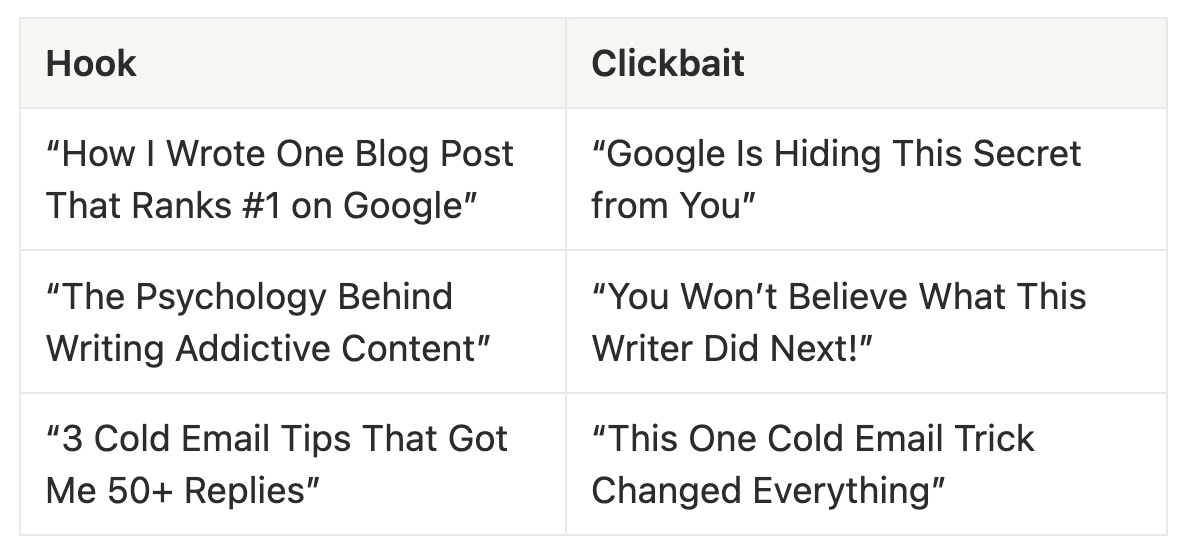
See the difference?
A good hook is specific, valuable, and sets clear expectations.
Clickbait is vague, emotional, and often sets unrealistic or dishonest expectations.
One respects the reader.
The other manipulates them.
Why Using a Hook Is Psychology
Here’s the deal:
Using a hook isn’t about tricking people.
It’s about understanding how humans process information and using that insight to present your content in a way that resonates.
People are bombarded with messages 24/7.
To decide whether to click, they ask themselves:
“Is this worth my time?”
“Will I get something valuable?”
“Is this for me?”
A well-crafted hook answers those questions upfront.
You’re helping your audience make an informed decision, not pulling a fast one.
How to Write a Hook That Respects Attention
Alright, time to get practical.
Want to write hooks that engage without deceiving?
Here’s your cheat sheet:
1. Start with the Reader’s Problem
What pain point, curiosity, or question is already in their mind?
“Struggling to grow your blog traffic? You’re not alone, but here’s a system that works.”
2. Be Clear, Not Clever
Don’t bury the value in fancy words.
Let it shine.
❌ “Revolutionary Tactics You’ve Never Heard Of”
✅ “3 SEO Tweaks That Boosted My Traffic by 70%”
3. Use Numbers or Specifics
People love clear expectations. “10-minute read” or “2x conversion rate” gives instant value.
4. Tease, But Don’t Lie
A little curiosity is gold. Just make sure what follows lives up to the setup.
“The one sentence that doubled my email replies (and why it works)”
Respecting Attention Is the Real Win
Look, in a world of endless content, your audience’s attention is sacred.
When someone gives you their time, that’s trust.
That’s a gift.
A well-crafted hook helps them decide, “Yes! This is so worth it.”
It doesn’t bait them into wasting five minutes.
It welcomes them into an experience that has actual value.
So when you’re writing your next headline, email subject, or intro paragraph, ask yourself:
Am I being honest?
Am I clear about the value?
Am I delivering on what I promise?
If the answer’s yes, you’re not being manipulative.
You’re being a smart, thoughtful communicator.
TL;DR - Don’t Be Scared to Hook People
Here’s the takeaway:
A hook isn’t clickbait if the content delivers.
Clickbait overpromises and underdelivers, a good hook does the opposite.
You’re not tricking anyone, you’re helping them choose how to spend their time wisely.
Be clear, specific, honest, and always make sure the value follows the click.
What Now?
So next time you’re worried your hook sounds “too catchy,” pause.
Ask yourself: Am I delivering what I promised?
If yes, you’re doing it right.
Wanna get better at writing hooks that actually work (and don’t ruin your reputation)
Start paying attention to the ones that hook you, and dissect why they worked.
Then go out there and respect your reader’s time… one line at a time.
Continue The Rabbit Hole…
Learn how to write killer hooks that grab attention and drive results using Alex Hormozi’s psychological tactics.
And grab the ultimate mega prompt that I now use to create 50 awesome hooks!
How I Write Hooks That Actually Work (Alex Hormozi’s Proven Method)

Let’s unpack the psychology, structure, and strategy behind attention-grabbing content.
FREE Hook + Content Generator
Generate tailored viral hooks, content, and CTAs for your favourite social media platform in seconds!

Not a paid member yet?
Upgrade to paid access now to unlock the Premium Vault, join monthly live trainings, and get access to the AI Toolbox and Action Lab.
Want to read more about the FULL benefits of being a Paid Subscriber?

You’ll gain exclusive access to:


Let’s crack the growth equation and build a thriving one-person business on your terms!
Anfernee
My printer is on... Going to read this on paper. .
=)
By hook or by crook...
I'm reading this post a second time.
It's that good.