How I Write Hooks That Actually Work (Alex Hormozi’s Proven Method)
Learn how to write killer hooks that grab attention and drive results using Alex Hormozi’s psychological tactics. And grab the ultimate mega prompt that I now use to create 50 awesome hooks!

Access your FREE Solopreneur Success Hub - your subscribers-only comprehensive command center for building and scaling a successful one-person business.
I created this all-in-one toolkit for building a profitable one-person business, something I wish existed when I first started, and it saves me 20+ hours a week.
Now, it’s yours… FREE!
More information about the Hub here.
Hooks aren’t just catchy phrases.
They’re the difference between going viral or going unnoticed.
Inspired by Alex Hormozi’s obsession with getting attention, this post breaks down the real mechanics behind hooks that actually work.
Let’s unpack the psychology, structure, and strategy behind attention-grabbing content.
Paid Subscriber Bonus: I’ve also provided the ultimate mega prompt that I now use to create 50 awesome hooks strategically target different levels of audience awareness.
Let’s Get Real: Great Hooks Alone Won’t Save You
Before we dive into the magic of hooks, here’s a reality check: a killer hook won’t make your content go viral if no one sees it.
Yup, you still have to play the game that almost everyone knows but refuse to do, post consistently, build an audience, and engage with others.
Think of the hook as your best weapon, but if you don’t show up to the battlefield, it’s not going to do much.
Why Alex Hormozi is Obsessed with Hooks
If you’ve watched any of Alex Hormozi’s videos, you’ve probably noticed one thing: he gets straight to the point.
No filler, no BS, just a punchy hook that grabs you your attention and make you want to continue watching.
So, why does Hormozi put so much effort into the hook?
Attention Is the Real Currency
You can’t sell what no one sees.
In today’s world, attention is everything.
Whether it’s a TikTok, email subject line, or YouTube ad, if your first 5 seconds don’t stop the scroll, game over.
Lesson: The hook is the sale before the sale. It earns you the right to deliver your message.
It’s Psychological Warfare
Hormozi doesn’t just use hooks, he engineers them based on how our brains are wired.
A great hook:
Triggers curiosity
Creates an open loop your brain needs to close
Makes your audience think: “Wait… what happens next?”
So, What Is a Hook, Really?
Let’s define it plainly.
A hook is:
The first impression your audience gets
The first few seconds of your video, ad, or post
The sentence or visual that stops them in their tracks
A good hook grabs attention and makes the audience go:
“Whoa! This is for me. I need to hear this.”
The Anatomy of a Great Hook
There are two major ingredients that make a hook powerful:
The Call Out (a.k.a. The Attention Grabber)
This is where you identify the audience or highlight the problem. It answers the question:
“Who’s this for?”
You want your ideal customer to hear it and think, “That’s me!”
Examples of Verbal Call Outs:
“Gym owners making less than $10K/month...”
“Moms who can’t get their kids to listen…”
“If you’re tired of working 80 hours a week and still broke…”
Nonverbal Call Outs (Visuals & Sounds):
Dressing like your audience (e.g., plumber for plumbers)
Showing the problem visually (e.g., tossing in bed = insomnia)
Using bright colors or shocking visuals to create contrast
The Condition for Value (a.k.a. The Promise)
This is where you promise value if they keep watching or reading.
You’re telling them, “Stick around and you’ll get X.”
Together, This Is The Format:
[Target Audience] + [Call to Action] = [Reward]
Examples:
“If you’re a remote worker, watch this video to avoid burning out in 6 months.”
“If you’re tired of guessing how to write copy, I’ll show you the 3-step formula pros use.”
Hook Types Based on Awareness Level
Not all audiences are created equal.
Hormozi tailors his hooks based on audience awareness, and so should you.
Understanding where your audience is in their awareness journey is crucial for crafting hooks that actually land.
Think of it like dating. What you say to a stranger is very different from what you’d say to someone who already knows and likes you.
This framework, originally developed by copywriting legend Eugene Schwartz, helps you match your messaging (and hook) with the mindset of your audience.
Let’s break each one down in detail:
1. Unaware (Curiosity Hooks)
Who they are:
These folks have no clue they even have a problem.
They’re scrolling TikTok, checking emails, or watching YouTube with zero intention of solving a problem.
Your job:
Interrupt their pattern. Spark curiosity or surprise that makes them suddenly interested.
Best hooks:
Use pattern interrupts, curiosity, or intrigue.
Open with a bold statement, shocking stat, or unusual scenario.
Examples:
“This one tiny habit is ruining your life (and you don’t even know it).”
“Most people fail at business for a reason they never see coming...”
“I never thought one decision would wreck my health—but here we are.”
Why it works:
They’re not problem-aware, so you can’t talk about solutions or products yet.
Curiosity leads them into the funnel.
2. Problem-Aware (Pain-Driven Hooks)
Who they are:
They know something’s wrong.
They feel the pain.
But they haven’t found a solution (or maybe they’ve tried a few that didn’t work).
Your job:
Agitate the pain, make it real, and show that you understand it better than anyone else.
Best hooks:
Highlight the cost of inaction
Make them feel understood
Reflect their frustration
Examples:
“You’re grinding 10 hours a day, and your business still isn’t profitable? That’s not a work ethic issue, it’s a model issue.”
“Struggling to lose weight even after counting every calorie? Yeah, me too—until I tried this.”
“Tired of living paycheck to paycheck even though you work harder than most?”
Why it works:
You’re entering the conversation already happening in their mind.
When they feel seen, they’re more likely to engage.
3. Solution-Aware (Promise-Driven Hooks)
Who they are:
They know the problem.
They know solutions exist.
But they don’t know your solution or what makes it different.
Your job:
Sell the benefit of your approach. Promise speed, ease, or results that differentiate your solution from others.
Best hooks:
Focus on “fastest way”, simplest solution, or unique method
Highlight the outcome, not the process
Examples:
“The fastest way to build a profitable coaching business with zero paid ads.”
“This 3-step system helps remote workers eliminate burnout in 30 days.”
“No-funnel? No problem. Here’s how I landed $20K clients using only DMs.”
Why it works:
They’re already seeking a fix. You need to be the one offering the better, faster, easier one.
4. Product-Aware (Proof-Driven Hooks)
Who they are:
They know products like yours exist.
Maybe they’ve even heard of you.
But they haven’t bought yet.
Your job:
Build trust, show proof, and provide evidence of results. Remove doubt.
Best hooks:
Showcase case studies, social proof, testimonials
Mention specific numbers and outcomes
Examples:
“Why 10,000 freelancers are switching to our no-code design platform.”
“See how this busy mom doubled her income using our email templates.”
“The system that helped 47 creators go full-time—without a single paid ad.”
Why it works:
They’re on the fence. You’re showing them they’re not alone and others like them are winning with your product.
5. Most Aware (Offer-Driven Hooks)
Who they are:
These are your warmest leads.
They know your brand, your product, your content.
They might even be on your list.
They just need a push.
Your job:
Give them a clear reason to act now. Use urgency, scarcity, or special deals.
Best hooks:
Promote exclusive offers, discounts, or limited-time bonuses
Speak directly to loyal fans or subscribers
Examples:
“Only 24 hours left to join the Creator Launchpad with 50% off.”
“Last call: Get a bonus 1:1 coaching session when you enroll today.”
“Enrollment for this cohort closes tonight—don’t miss your chance.”
Why it works:
These people already want what you offer.
You just need to close the loop with a timely reason to act.
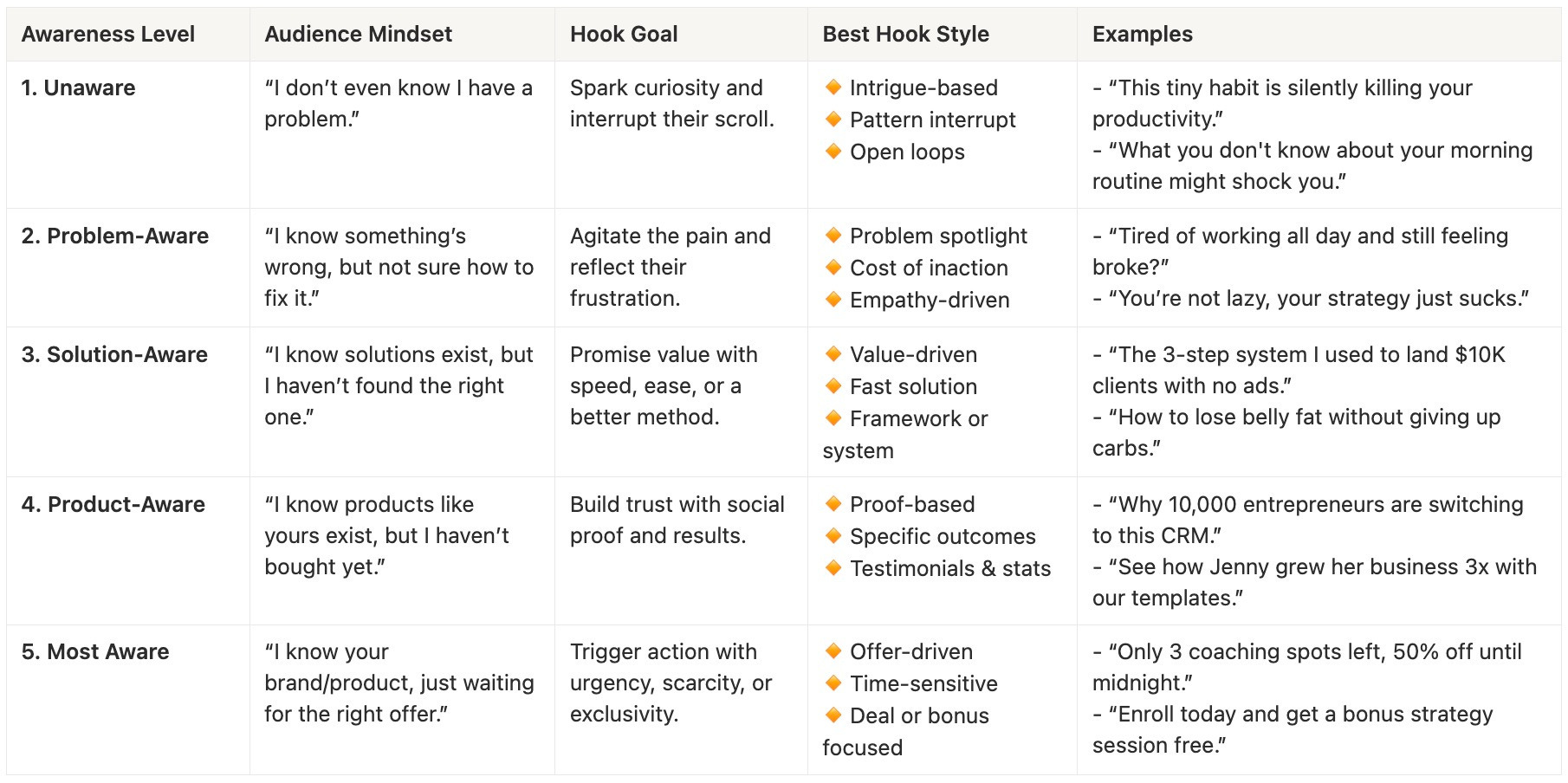
Here’s An Overview
Pro Tip: Mix Them Up!
If all your content only targets “Most Aware” (i.e., people already following you), you’ll miss out on a huge chunk of the market.
Smart marketers mix hook types to:
Attract cold leads with curiosity
Build warm relationships with proof and solutions
Convert hot leads with offers
So ask yourself before writing any hook:
Where is my audience in their awareness journey?
Once you know that, writing the right hook becomes way easier and way more effective.
The 70-20-10 Hook Creation Rule (Hormozi-Style)
Creating hooks is not just about brainstorming ideas on a whim.
There’s a system behind it.
Here’s how to allocate your energy:
70% - What’s Already Working
Reuse proven hooks from your best-performing videos, posts, emails.
Repurpose from competitors or adjacent niches.
Example: Take a viral YouTube Short and turn it into a tweet.
20% - “Winner Adjacent”
Tweak your winners to test new variations.
Model success in other industries.
Example: Take a high-performing real estate hook and adapt it for fitness coaches.
10% - Wild Experiments
Try bold, risky ideas.
Experiment with new formats, strange openings, unique visuals.
Example: Open a video with complete silence or a backwards phrase.
Most of your hooks should be boringly consistent. Some should be borderline insane.
Real-World Hook Examples (With Breakdown)
Let’s break down some great hook formats:
Direct Problem Statement:
“You’re broke because your business isn’t a business, it’s a job.”
✅ Clear audience
✅ Specific pain point
✅ Emotional sting
Curiosity Question:
“What if I told you the reason your ads aren’t working has nothing to do with the ads?”
✅ Intrigue
✅ Implication of value
✅ Open loop
Specific Result:
“How I made $11,372 from a single Instagram DM”
✅ Proof
✅ Tangible result
✅ Makes you want the “how”
Final Tips for Writing Killer Hooks
Here’s your cheat sheet:
✅ Keep it short (1–2 sentences max)
✅ Use power words and emotional triggers
✅ Make it feel personal
✅ Use numbers, questions, and tension
✅ Focus on the first 5 seconds for both video or text
✅ Always test multiple variations
Takeaway
If there’s one skill that moves the needle in content creation, it’s this: hook writing.
It’s not about being clever.
It’s about understanding human psychology, audience pain points, and how to make someone stop scrolling for just long enough to hear what you have to say.
Hook = Attention
Attention = Opportunity
Opportunity = Growth
So yeah, write more hooks.
Spend more time crafting them.
Reuse the good ones.
Study the great ones.
Test like a mad scientist.
And remember: attention is everything.
FREE To Use Hook + Content Generator
I’ve also created an AI-Powered Hook + Content Generator.
Instead of wasting hours trying to force creativity, you:
Pick your platform (X, Instagram, LinkedIn, Facebook, and more)
Type your idea
Get 5 scroll-stopping hooks, 5 optimized posts, and 5 CTAs instantly.
No more blank pages.
No more mental wrestling matches.
Just ready-to-go, high-impact content tailored to where you’re posting.
It’s completely free.
Just open it and start creating.
Paid Subscribers’ Bonus: Instantly Generate 50 Killer Hooks
If you’re serious about mastering the art of the hook (and you should be), here’s a powerhouse AI prompt designed to give you a massive head start.
I called it the Irresistible Hook Architect and it’s built specifically for creators, marketers, and business owners who want to produce hooks that are:
Attention-grabbing,
Audience-awareness aligned, and
Value-packed.
This prompt guides AI to act as a Hook Architect, a pro-level copywriter trained to build hooks based on audience psychology, awareness levels, and proven persuasion tactics.
Whether you’re writing ads, scripts, captions, or emails, this prompt helps you generate 50 strategic hooks, categorized by awareness level and tailored to your exact offer.
Copy + paste the prompt, input your avatar’s pain and dream outcome, and let the AI do the heavy lifting.
You’ll walk away with:
Hooks for every stage of the funnel (Unaware to Most Aware)
Copy that stops the scroll and boosts conversions
A repeatable system you can use forever
What I Get By Using The Prompt
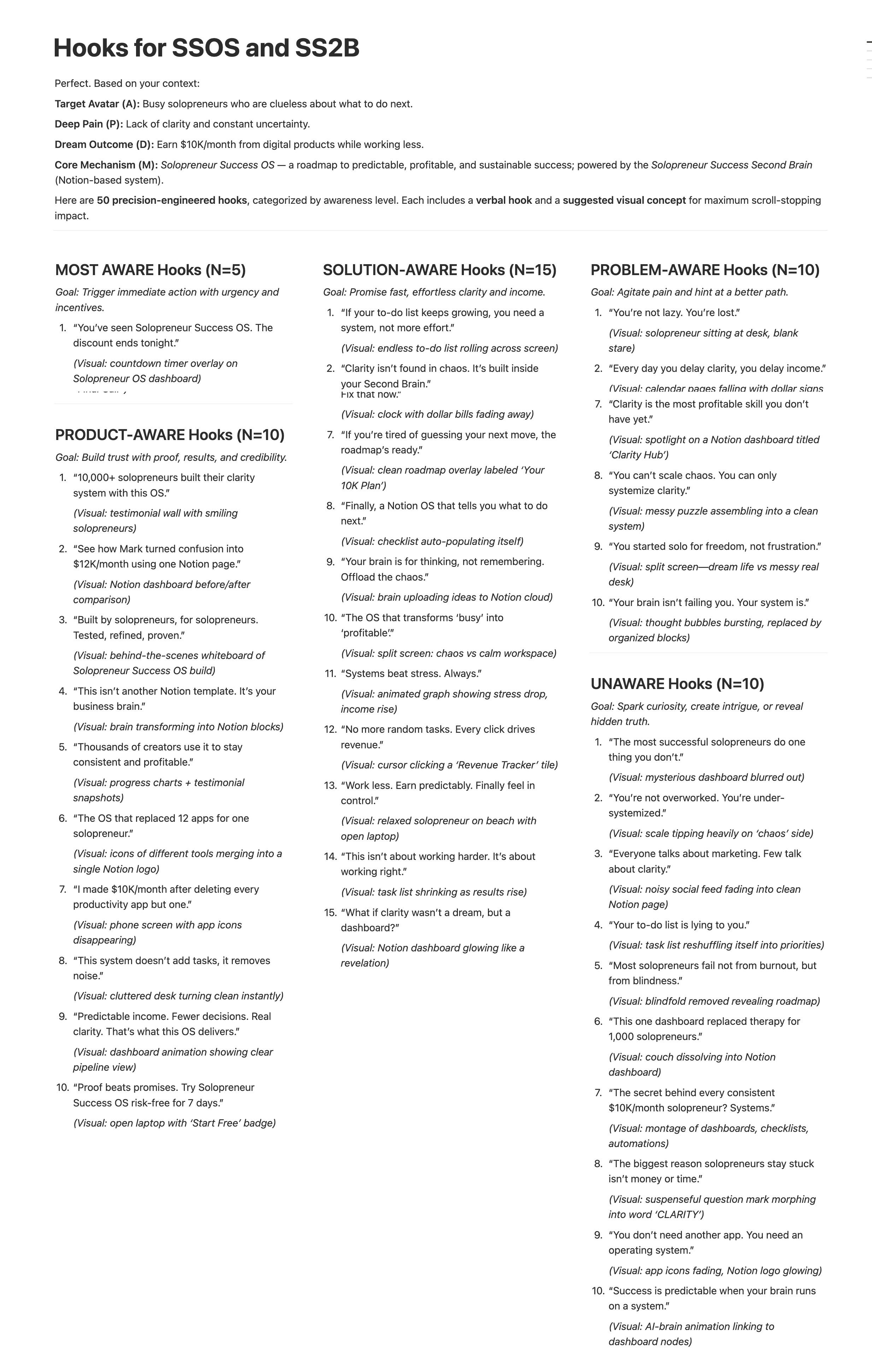
This is what I get when I use the prompt to generate hooks for my Solopreneur Success Second Brain.
They’re AMAZING!