
How to Build a Substack Audience Growth System That Works (Even With a Small List)
Posting consistently is not a growth strategy! Here's the system that actually brings in new subscribers week after week, without burning out or chasing every new platform.

Access your FREE Solopreneur Success Hub - your subscribers-only comprehensive command center for building and scaling a successful one-person business.
I created this all-in-one toolkit for building a profitable one-person business, something I wish existed when I first started, and it saves me 20+ hours a week.
Now, it’s yours… FREE!
SECTION 1: What the Audience Growth System Is
You’re posting twice a week. You’re showing up. The subscribers still aren’t coming.
This is the most common frustration I hear from Substack writers. They treat publishing as their growth strategy, then wonder why the numbers don’t move.
Publishing is not growth. It’s the product.
Growth is a separate system entirely.

The Audience Growth System is the set of repeatable actions that bring new subscribers to your newsletter, consistently, without requiring you to reinvent your approach every month.
For solopreneurs running a one-person newsletter, this matters for one specific reason: you don’t have a marketing team.
Every new subscriber either finds you through something you set up deliberately, or they don’t find you at all.
The system has four core components:
Acquisition sources: the channels where new subscribers discover you
Cross-promotion: structured relationships with other writers who send their readers your way
Discoverability: optimizing your Substack profile, posts, and Notes so the platform surfaces you
Daily engagement: the consistent in-platform activity that keeps you visible between publications
Most writers work on one or two of these. The system runs all four in parallel.
When this system works, subscriber growth becomes predictable.
You stop checking your numbers in a panic after every post.
You know where your growth is coming from, which channels are performing, and what to keep doing.
SECTION 2: How I Set Mine Up
I want to be clear about something first: I didn’t build this system all at once. I added one layer at a time, refined each one, and now it runs as a weekly routine I don’t have to think about much.
Here’s what it looks like today.
My tools for audience growth:
Substack (Recommendations, Notes, Chat, Guest Posts)
SubflowAI (built by Dheeraj Sharma , used for my daily Notes workflow)
Notion AI and Claude (weekly planning, post ideas, Notes ideas, audience analysis)
My current setup, step by step:
Two posts a week, every week. Tuesday is the standard newsletter. Sunday is this series. Consistency builds the baseline. Every post is also a discovery surface for new readers.
5 to 10 Substack Notes per day. This is the highest-volume growth activity I do. Notes are how Substack’s algorithm surfaces you to readers who don’t follow you yet. I currently use SubflowAI by Dheeraj Sharma to help me stay consistent here without burning time. I have tried multiple systems out there and decided to camp here. Over a week, that’s up to 70 Notes in front of new audiences.
10 to 20 engagements per day. Likes, comments, and restacks on other writers’ content. I focus on posts where my audience would also be reading. Engagement keeps me visible inside the ecosystem and builds genuine relationships with other writers. I will talk more about engagement systems in the next post.
Substack Recommendations. I now have more than 130 Substack publications recommending Solopreneur Code to their readers. That didn’t happen by accident. I recommend newsletters I genuinely believe in, ones aligned with what my subscribers need, and many of those writers recommend me back. This single channel contributes thousands of subscribers over time.
Guest posts through the First Digital Dollar Project. I’m currently writing about 20 solopreneurs and how they earned their first digital dollar. Each subject is a real person with their own audience. When the post goes live, it gets shared. Their readers discover me. My readers discover them. Both sides grow.
Daily Signal in the Substack Chat. I run a weekday chat series: Monday through Saturday, a different prompt each day. It’s a live engagement loop that keeps existing subscribers active and gives new subscribers a reason to stay. Active communities show up in Substack’s recommendation engine.
Weekly welcome email on Tuesdays. Every week I send a dedicated welcome email to all new subscribers from the past seven days. This is not automated. It’s personal. It tells them what they’ve joined, what’s coming, and how to get involved. First impressions matter for retention.
Quarterly audience analysis. Every quarter, I download my subscriber metadata and run it through Claude. I ask it to identify the best times to reach my audience, where subscribers are located, and any patterns in when growth spikes. That informs my posting schedule and engagement timing for the next quarter.
The honest note: none of these channels failed outright. What I refined over time was the timing and focus. Posting at the wrong time of day, engaging on topics outside my niche, writing Notes with no clear angle. Every one of those adjustments was small, but they compounded.
The result right now: 100 to 150 new subscribers per week, consistently.
SECTION 3: How to Build Yours, The Complete Guide
Part A: Readiness Check
Before building your audience growth system, it helps to know exactly where your gaps are.
Answer these honestly:
1. Do you know where your current subscribers come from? Not roughly. Specifically. If someone asked you which channel sent the most subscribers last month, do you have a number, or do you have a guess?
2. How many Notes did you post last week? Not how many you intended to post. How many actually went out? If the answer is zero or one, your discoverability on Substack is close to zero too.
3. Have you reached out to another writer in the last 30 days to explore a recommendation swap or guest post? Cross-promotion doesn’t happen through wishful thinking. If you haven’t initiated a conversation, you don’t have a cross-promotion system. You have a vague intention.
4. What happens when a new subscriber joins your newsletter today? Do they get a welcome sequence that tells them what they’ve joined? Or do they land in your archive with no introduction, no context, and no reason to stay?
5. When did you last review your subscriber data to find patterns in growth? If you’ve never done this, you’re making decisions about your growth strategy without looking at the evidence.
If reading those questions created some discomfort, that’s the point.
The gap between where you are and 100 new subscribers a week is almost always a systems gap, not a talent gap. The next part of this guide closes it.
You now know where your gaps are.
The rest of this guide covers how to close them.
What follows includes the step-by-step setup for all four growth components, tool recommendations at every budget level (including free), the five most common audience growth mistakes Substack writers make, and a weekly maintenance schedule you can run in under 30 minutes.
Here is a preview:
The first thing to set up is your acquisition source map. Most writers have three to five channels sending them subscribers, but they’re only aware of two. Before you optimize anything, you need to know which channels are actually working. The way to do this is to open your Substack dashboard and pull the last 90 days of subscriber data. Sort by source. What you find will probably surprise...
Become a paid subscriber to read the full guide.
You’re doing everything. But nothing is moving?
You are doing everything. But nothing is moving.
That is not a motivation problem.
Most solopreneurs are learning from everywhere and getting nowhere. Too much information. No clear system connecting effort to results.
You have everything it takes. You just do not have a clear system yet.
That is what paid subscribers get. Every system, playbook, prompt, and template. All inside the Premium Vault.
All for $79/year. That’s $6.58/month.
Upgrade now and unlock the Premium Vault.


Part B: Full Setup Guide
This guide covers how to build all four components of your audience growth system from scratch.
Work through it in order the first time.
After that, use the maintenance schedule at the end to keep it running weekly.
Step 1: Build Your Acquisition Source Map
Before you optimize anything, you need to know what’s already working.
Open your Substack dashboard. Go to Growth > New Subscribers, then view all the source. Pull the last 90 days. You’ll see a breakdown of where subscribers came from: direct, Substack recommendations, search, external links, and more.
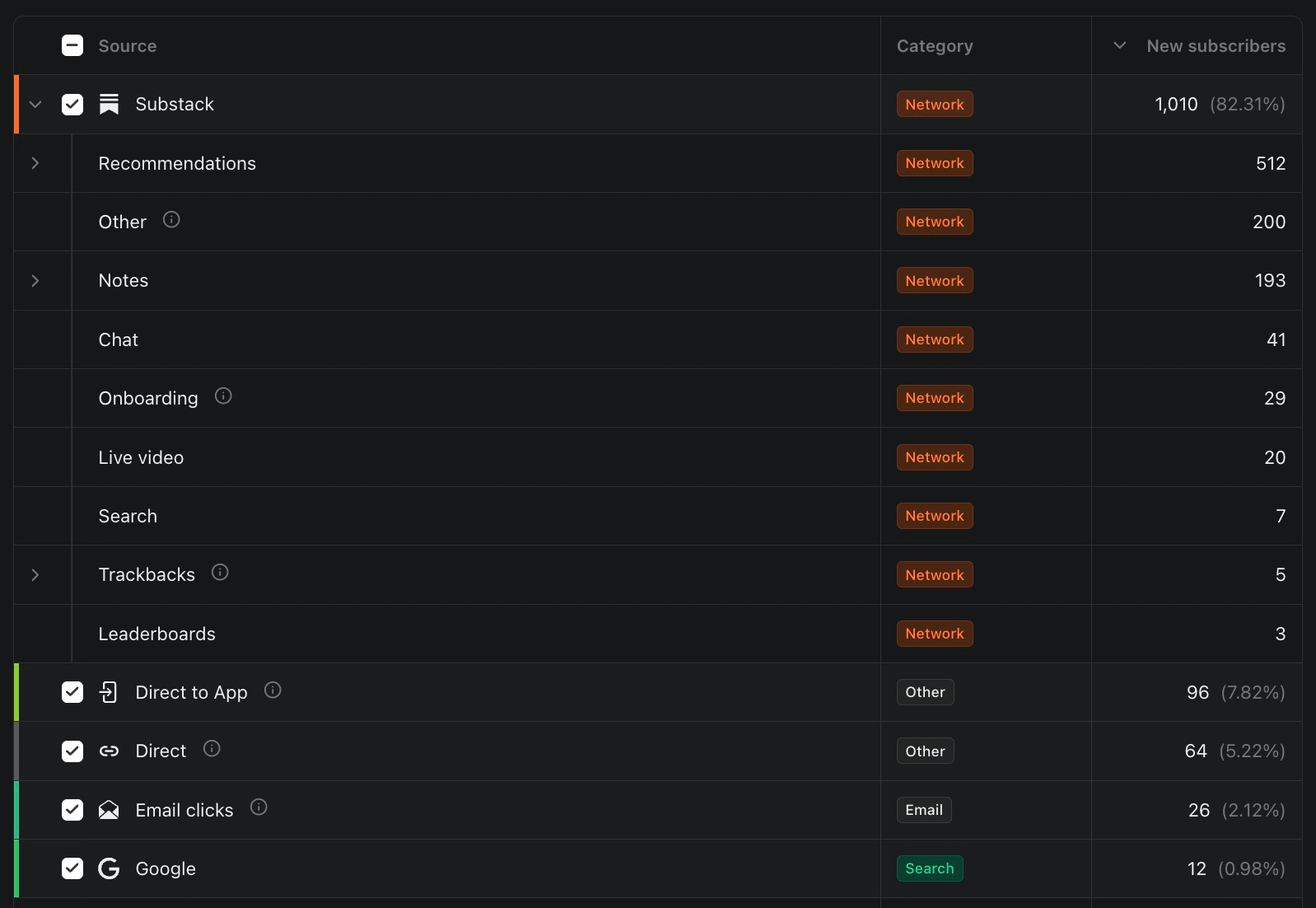
Your job is to identify your top two or three sources. Those are the channels already doing the work. Everything else is secondary.
Why this matters: Most writers optimize the wrong thing. They double down on social media because it feels like growth, when their actual top channel is Substack Recommendations or organic search. The data tells you where to put energy.
Decision point: If you have no data yet (under 50 subscribers), skip this step and return to it in 60 days. For now, activate all four channels below and let data accumulate before you prioritize.
Once you know your top sources, create a simple tracking note in Notion (or wherever you keep records). Log the source breakdown once a month. Over time, you’ll see which channels are growing, plateauing, or declining.
Step 2: Activate Your Substack Recommendations Strategy
Substack Recommendations is the highest-leverage growth channel on the platform. When another publication recommends you, their subscribers see your newsletter in their welcome flow and in their app.
A single strong recommendation from an aligned publication with 5,000 subscribers sends real, qualified readers your way.
Here’s how to build this channel systematically:
Go to your Substack settings. Find Recommendations. Add 5 to 10 newsletters you genuinely read and respect, ones your subscribers would also value.
Write personal outreach to the writers you recommend. Tell them you’ve added them, that you respect their work, and that you’d appreciate a recommendation if they feel your content serves their readers. The Substack Accelerator Kit includes a Recommendation Request template you can adapt for this.
Track who you’ve contacted and who has responded. A simple table in Google Sheet or Notion works: name, publication, date contacted, status.
Repeat monthly. Add new recommendations as you discover quality writers. The goal is a growing network of mutual recommendations, built on genuine alignment.
A note on the Substack Accelerator Kit:
If you’re building your cross-promotion pipeline for the first time, the Collaboration Templates inside the Substack Accelerator Kit give you three ready-to-use frameworks:
the Guest Contributor Invitation,
the Cross-Promotion Partner Email, and
the Recommendation Request.
This guide tells you the logic and sequence behind when and how to use them. The Kit gives you the copy. Use both together.
The BONUS 100 Viral Substack Notes Templates inside the Kit also pairs directly with Step 3 above. The templates give you starting angles.
Your job is to make each one specific to your niche and your experience.
Decision point: If you’re under 500 subscribers, focus on quality over quantity. One recommendation from a 10,000-subscriber writer aligned with your niche beats five from newsletters with 200 subscribers and no audience overlap.
Step 3: Build Your Daily Engagement Routine
Engagement is not networking. It’s visibility work.
