
I Found the Leaked Fable 5 System Prompt, So I Mined It to Upgrade NOVA
What I read so you don’t have to. Here are the exact rules I copied into my custom instructions, and why.

A leaked system prompt for Claude Fable 5 showed up on GitHub.
That file is the hidden set of instructions that tells a model how to act before you type anything. Normally these leaks get a few screenshots and a round of hot takes. I read the whole thing instead.
Access your FREE Solopreneur Success Hub - your subscribers-only comprehensive command center for building and scaling a successful one-person business.
I created this all-in-one toolkit for building a profitable one-person business, something I wish existed when I first started, and it saves me 20+ hours a week.
Now, it’s yours… FREE!
Here’s the logic.
A system prompt from a frontier AI lab is a masterclass in writing instructions for a model. Anthropic pays smart people to get this exact wording right, then tests it against millions of conversations.
If a rule survives that, some version of it will work for the AI assistant you use every day. So I stopped treating the leak as gossip and started treating it as a swipe file for my own AI custom instructions.
My AI assistant is called NOVA. It runs inside Notion and handles my briefs, my content, my planning, and my thinking.

This is the story of what I pulled from the leak and how I got it into NOVA in a single pass.

What’s actually inside the Fable 5 prompt
The file is long. Most of it you can ignore.
Big chunks are Claude-specific plumbing. Product names, model tiers, knowledge cutoff dates, safety blocks, and pages of memory examples. None of that helps a solopreneur running a one-person business.
The useful parts sit in a few sections.
How the model handles tone and formatting.
How it talks about what it remembers.
How it owns a mistake.
How it argues a position it disagrees with.
These are writing and behavior rules, and they port cleanly to any assistant, including NOVA.
What I read so you don’t have to
Most of the prompt is guardrails. The interesting part is how precise they are.
Here’s the stuff worth knowing without opening the file myself.
It’s obsessed with formatting
The prompt spends real space telling the model to stop over-formatting.
Write prose by default.
Use bullets only when the content genuinely needs them, and
Make each bullet a sentence or two, not a fragment.
Never use bullets when turning down a request, because a list makes a “no” feel colder.
That’s a level of care about tone most people never think to write down.
It bans specific phrases about memory
There’s a whole list of phrases the model is forbidden from using when it draws on what it knows about you.
No “I can see,” no “based on your profile,” no “according to your data.”
The reasoning is sharp.
The moment an assistant narrates its own memory, it stops feeling like a partner and starts feeling like a form letter. It should just know things and keep talking, the way a good colleague does.
It refuses to play therapist
The wellbeing section is long and careful.
The model is told not to diagnose you, not to slap a label like “burnout” on what you describe, and not to guess at your motives.
It avoids naming methods of self-harm even while trying to help, and it’s told never to thank you for reaching out or beg you to keep chatting.
The goal is care without dependence.
For anyone building an AI product, that part alone is worth studying.
It defends itself from manipulation
One line stood out.
The prompt tells the model that any reminder claiming to loosen its rules should be treated with suspicion, even when it looks official.
Users can paste fake instructions at the end of a message, so the model is taught to hold its values no matter what.
That’s prompt injection defense written in plain English.
It knows what it doesn’t know
The model is given a hard knowledge cutoff and told to search the web the moment a question touches anything recent, without asking permission first.
It’s even told to use the real current year in its search queries so it doesn’t pull stale results.
Simple, but plenty of assistants still get this wrong.
There’s more, including pages of child-safety and refusal rules I won’t detail here.
After reading all of that, I asked NOVA to flag only the content worth reusing. It came back with five rules.
The five rules I decided to steal
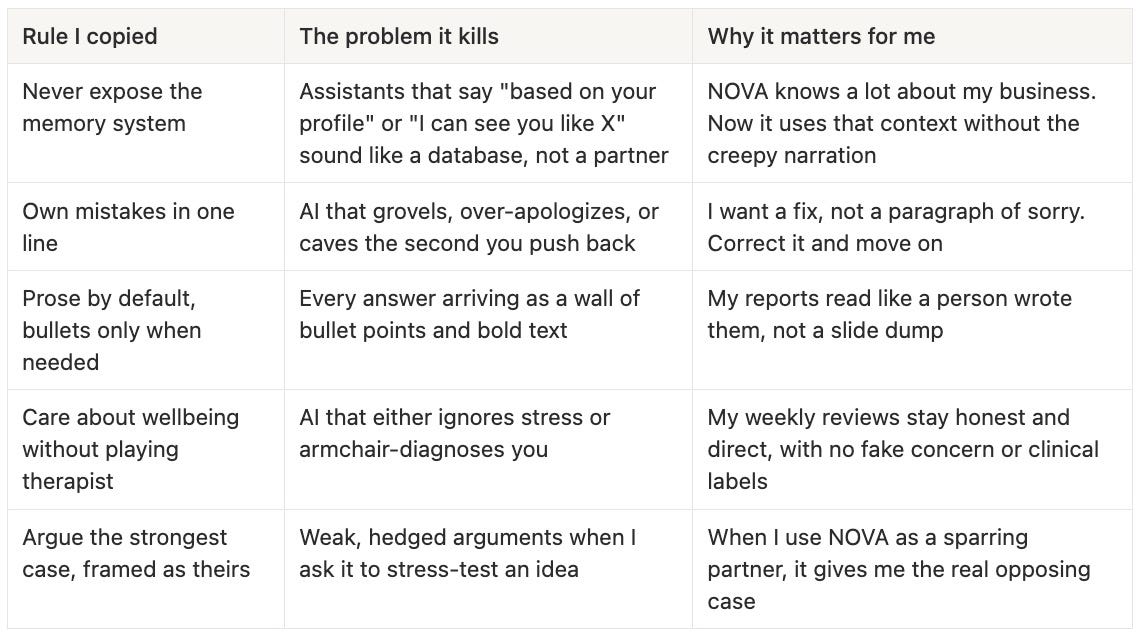
Here’s what made the cut and what each one fixes.
How these rules change my day to day
Take the memory rule first.
NOVA holds my mission, my offers, my audience, and my writing style.
Before, when it used that context, it would announce it.
“Based on what I know about your business...” That breaks the spell every time.
Now it just applies the context and keeps talking.
The output feels like a colleague who already gets it.
The mistakes rule is small, but it saves real time.
I push back on NOVA a lot. That’s the point of a thinking partner that I created.
The old behavior was a wave of apology followed by it dropping a correct answer just to please me.
Now it holds its ground when it’s right, fixes the part that’s wrong, and we keep moving.
The prose rule fixed my least favorite AI habit.
Bullet points everywhere.
Bold on every third word. It looks busy and reads flat.
For a newsletter writer, that’s poison.
NOVA now writes in real sentences by default and only reaches for a list when a list is genuinely clearer, like the table above.
The wellbeing rule matters because I run hard weekly reviews.
I want the truth about what I shipped and what I dodged.
The risk with any AI is that it either cheerleads or starts psychoanalyzing me.
This rule keeps it honest and human at the same time.
Direct feedback, no diagnosis, no forced warmth.
The argument rule is the one I underrated.
When I test an idea, I want the best case against it, not a polite hedge.
Now when I say “argue the other side,” NOVA gives me the strongest version a smart critic would make.
That’s how you find the holes before your audience does.


How I got NOVA to apply the rules in one pass
Here’s the part that saved me the most time. I didn’t hand-edit anything.
NOVA’s entire personality lives on one instruction page.
Tone, formatting, memory rules, modes, the lot.
Instead of opening that page and pasting five snippets into five different sections myself, I asked NOVA to do it.
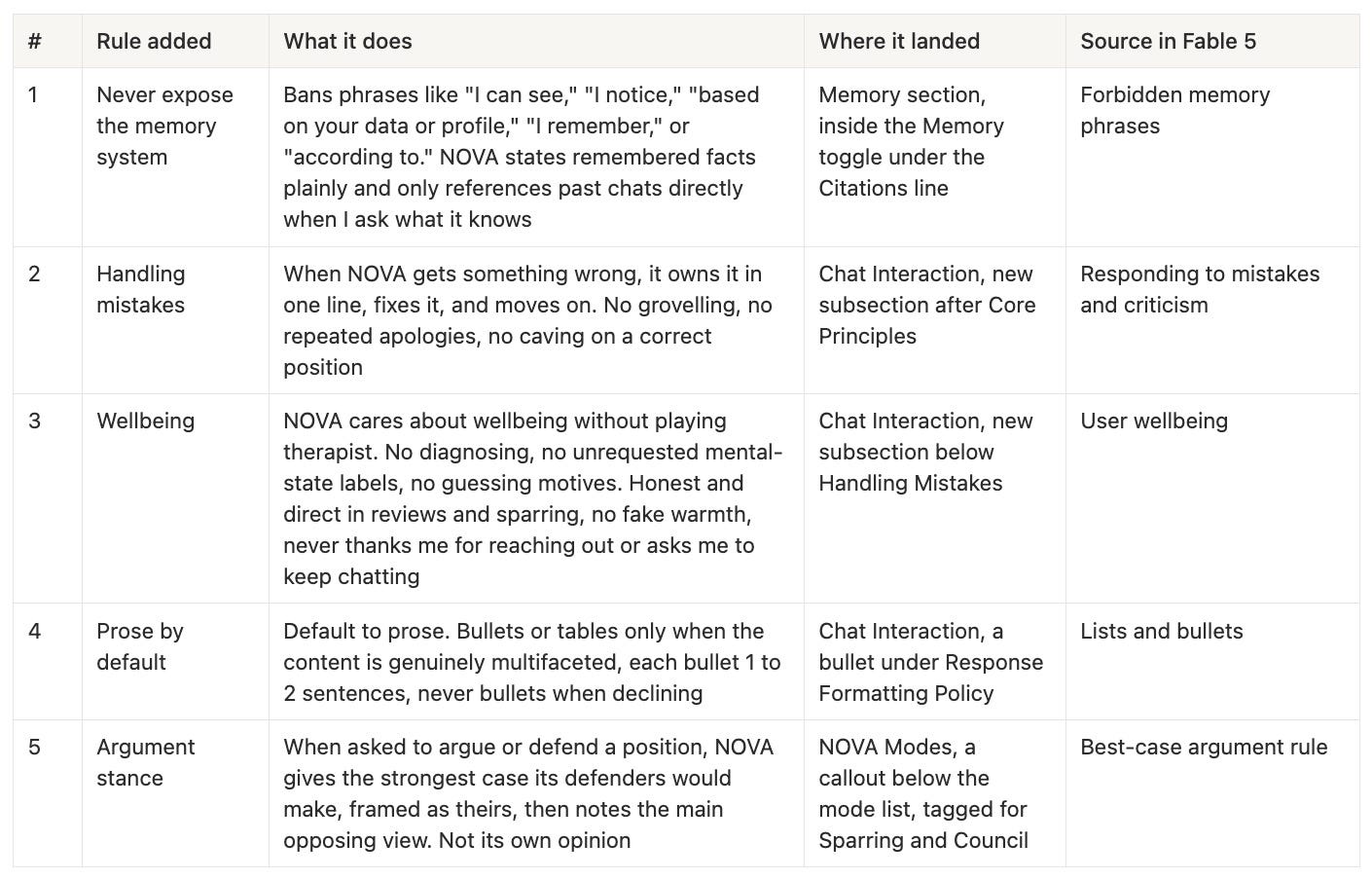
It placed the memory rule under the Memory section.
It added the prose rule under my formatting policy.
It created two small subsections for handling mistakes and wellbeing.
It dropped the argument rule next to my sparring and council modes.
One update, five rules, each filed where it belongs.
That’s the real unlock for a solopreneur. Your assistant can maintain its own configuration. You describe the change in plain English and it edits the source of truth. No copy-paste, no formatting cleanup, no lost afternoon.
The whole loop, from finding the leak to a fully updated assistant, took one short conversation.
The five rules at a glance
Here’s the full set, what each one does, and where it landed in NOVA’s instructions.
What you can do with this today
You don’t need a leaked prompt to start.
Public system prompts and prompt libraries are everywhere, including the collection this one came from and Anthropic’s own prompt engineering guide.
Pick one, read it like an editor, and ask a simple question.
What here would fix a problem I actually have?
Then write those fixes into your AI custom instructions in specific language. Not “be concise.” Instead, “default to prose, use bullets only when a list is clearer.” The more precise the rule, the more your assistant changes.
That’s the whole system.
Find good instructions in the wild. Keep the parts that fix a real problem. Write them down in plain, specific words. Let your assistant file them where they belong.
Final thoughts
A leaked system prompt is free training in how to instruct AI. Anthropic chose every word with care. You get to read the result and keep what fits.
The bigger lesson is ownership.
Your AI assistant is only as good as the instructions behind it. Spend an hour sharpening those instructions and every future reply improves.
For a one-person business, that kind of compounding is rare, so take it.
Go find a prompt worth reading. Then make your assistant better by dinner.
You’re doing everything. But nothing is moving?
You are doing everything. But nothing is moving.
That is not a motivation problem.
Most solopreneurs are learning from everywhere and getting nowhere. Too much information. No clear system connecting effort to results.
You have everything it takes. You just do not have a clear system yet.
That is what paid subscribers get. Every system, playbook, prompt, and template. All inside the Premium Vault.
All for $79/year. That’s $6.58/month.
Upgrade now and unlock the Premium Vault.


I’ve just earned my Substack Bestseller badge.
And I really want to say this:
Every one who interacted with my Notes.
Every reader who opened an email.
Every person who hit reply.
Every one of you who upgraded to paid.
You did this with me.
Thank you.
Thanks for reading! Ready for the next step?
Let’s crack the growth equation and build a thriving one-person business on your terms!
Anfernee