
Stop Waiting for Clarity. Here's How to Create It.
Why most people stay stuck and the 3-element framework to move forward

Access your FREE Solopreneur Success Hub - your subscribers-only comprehensive command center for building and scaling a successful one-person business.
I created this all-in-one toolkit for building a profitable one-person business, something I wish existed when I first started, and it saves me 20+ hours a week.
Now, it’s yours… FREE!
More information about the Hub here.
Most people think clarity is something you find.
A moment of insight.
A flash of inspiration.
A sign from the universe.
It’s not.
Clarity is something you create.
And it follows a simple formula.
The Problem With “Finding” Clarity
When people feel stuck, they usually do one of two things:
They collect more information. More courses. More books. More advice. They believe the next piece of knowledge will unlock everything.
They wait for motivation. They hope clarity will arrive like a package at the door. One day, they’ll just know what to do.
Neither works.
I know because I’ve been through it.
When I first started, I had no idea what I was doing. No clarity. No direction.
So I did what seemed logical.
I tried to learn everything.
I attended every course.
Read every article.
Scrolled through endless social media posts looking for answers.
The result?
More confusion.
After months of consuming information, I still had no clarity.
More information without direction creates noise.
Waiting without action creates stagnation.
The real issue?
Most people are missing a framework for how clarity actually works.
The Clarity Framework
Clarity requires three elements, in sequence:
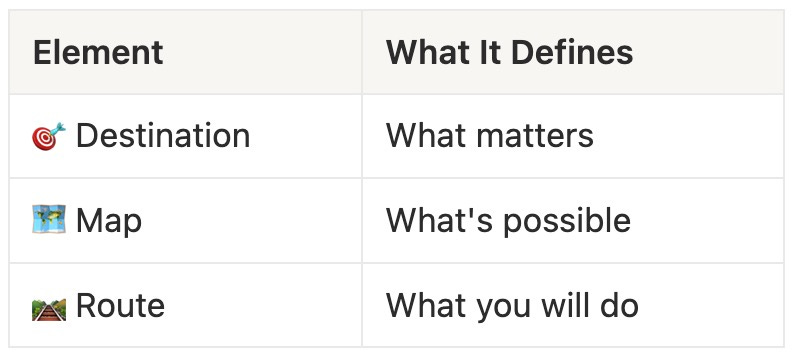
Destination - What matters
Map - What’s possible
Route - What you will do
When you have all three and commit to your route, clarity follows.
Let’s break each one down.
Destination: What Matters
The destination is your goal.
Your desired outcome.
The answer to:
Where do I want to end up?
Without a destination, every direction looks the same.
You can have the best map in the world, but if you don’t know where you’re going, you’ll wander.
Most people skip this entirely.
They jump straight to tactics: “I need a website.” “I should post on LinkedIn.”
But tactics without a destination are just motion without progress.
Define your destination in concrete terms.
Not “I want to be successful” but “I want to earn $10K/month from my own business within 12 months.”
Write it down.
Make it specific.
Give it a timeframe.
Make it SMART!
Need help defining your SMART destination? Try this AI Prompt: Define Your Destination
How to Use This Prompt
Fill in your vague goal and current situation
Paste into any AI tool (Claude, ChatGPT, etc.)
Answer the clarifying questions it asks
Choose the SMART goal version that resonates most
Write it down and use it as your destination
This forces specificity without overwhelming you with options.
I need help turning my vague goal into a concrete SMART destination. Help me make it Specific, Measurable, Achievable, Relevant, and Time-bound.

MY VAGUE GOAL OR DIRECTION:
[Describe what you want in general terms. Example: "I want to make money online" or "I want to be a content creator" or "I want more freedom"]

MY CURRENT SITUATION:
- Current income/status: [Where you are now]
- Available time: [Hours per week you can commit]
- Key skills: [What you're good at]
- What matters most to you: [Money, time freedom, impact, creative expression, etc.]

WHAT I NEED FROM YOU:

1. Ask me 3-5 clarifying questions to make my goal more specific
2. Based on my answers, draft 2-3 possible SMART goal versions
3. For each version, show me:
   - Specific: Exactly what I will achieve
   - Measurable: The number or metric I can track
   - Achievable: Why this is realistic given my situation
   - Relevant: Why this matters to me
   - Time-bound: The deadline

4. Recommend ONE version and explain why it's the best fit in 2-3 sentences

OUTPUT FORMAT:
Give me a single sentence destination statement I can write down and commit to.

Example: "Earn $5,000/month from freelance writing by December 31, 2026"
Map: What’s Possible
The map is your understanding of the terrain.
The options available.
The paths others have taken.
A map includes:
Strategies that work in your space
Resources you have access to
Constraints you’re working within
Examples of people who’ve reached similar destinations
Here’s where people get stuck: they collect “maps” endlessly.
Reading every book.
Taking every course.
Consuming without acting.
This feels productive but keeps you stuck at the trailhead.
You don’t need perfect information.
You need enough information to see 2 to 3 viable routes.
Then stop researching.
Need help building your map? Try this AI Prompt: Build Your Map (What's Possible)
How to Use This Prompt
Fill in your destination and current situation
Paste into any AI (Claude, ChatGPT, etc.)
Review the 2-3 routes it suggests
Pick one and stop researching
This keeps you from collecting maps endlessly and pushes you toward decision.
I need help building a minimal map to reach my destination. My goal is to identify 2-3 viable routes without over-researching.

MY DESTINATION:
[Insert your specific destination here. Example: "Earn $10K/month from my own business within 12 months"]

MY CURRENT SITUATION:
- Skills: [List your key skills]
- Resources: [Time, budget, network, tools you have access to]
- Constraints: [What limits you - time, money, location, skills gaps]

Make sure you ask me for specific answers if I did not provide.

WHAT I NEED FROM YOU:

1. Identify 2-3 realistic routes people have used to reach similar destinations
2. For each route, tell me:
   - What strategy it uses
   - What resources it requires
   - What the typical timeline looks like
   - One real example of someone who took this route successfully

3. Compare the routes in a simple table:
   - Time to first result
   - Upfront cost
   - Required skills
   - Biggest risk

4. Recommend ONE route based on my situation and explain why in 2-3 sentences

IMPORTANT: Keep this focused. I don't want every possible option. I want enough information to choose a route and start, not endless research.
Route: What You Will Do
The route is your chosen path.
The specific sequence of actions you will take to move from where you are to your destination.
This is where most people freeze.
They see multiple routes on the map.
Each looks reasonable.
Each has trade-offs.
So they wait.
They analyze. They compare. They ask for more opinions.
And nothing happens.
The truth: There is rarely one “right” route. Most routes can work if you commit to them. The cost of indecision is higher than the cost of choosing a suboptimal path.
This is one of the reasons I created the First Digital Dollar Project.
In this series, you’ll find out how 20 solopreneurs with different products, different offers, different strategies, different paths earn their first digital dollars.
The entire series is FREE for everyone. Just subscribe and get the stories in your inbox.
But what if I choose wrong?
This is the fear that keeps people frozen.
“What if I waste three months building the wrong thing? What if I invest money in a strategy that doesn’t work?”
The fear is legitimate.
But here’s what people miss: indecision has a cost too.
And it’s almost always higher.
Let’s compare:
Cost of testing a route for 90 days:
You invest time and effort
You learn what works and what doesn’t
You gain clarity on what to adjust
You build skills and momentum
If it fails, you have data to inform your next attempt
Cost of staying stuck for 90 days:
You make zero progress toward your goal
You consume more information without applying it
Your confidence erodes
You remain confused about what to do
After 90 days, you’re in the exact same place
One path gives you information. The other gives you nothing.
Most routes don’t fail completely.
They reveal what needs adjustment.
You learn that your pricing is wrong, or your messaging needs work, or your audience is slightly different than you thought.
That’s not failure. That’s progress.
The only true waste is spending months deliberating without testing.
The fix: Pick a route. Set a timeframe to test it. Evaluate after. Adjust if needed.
Need help committing to a route and building your test plan? Use this AI prompt:
How to Use This Prompt
Fill in your destination and the 2-3 routes from your map
Paste into any AI tool (Claude, ChatGPT, etc.)
Review the test plan it creates
Write down your start date and first action
Stop planning and start executing
This forces commitment and gives you a concrete test plan, removing the last excuse to delay.
I've identified my destination and mapped out possible routes. Now I need help committing to ONE route and building a concrete test plan.

MY DESTINATION:
[Your SMART goal. Example: "Earn $10K/month from my own business within 12 months"]

MY TOP 2-3 ROUTES:
[List the routes you're considering. Example:
1. Freelance consulting in my expertise area
2. Build and sell digital products
3. Start a paid newsletter]

MY CURRENT SITUATION:
- Available time: [Hours per week]
- Budget for testing: [Amount you can invest]
- Biggest strength: [What gives you an advantage]
- Biggest constraint: [What limits you most]

WHAT I NEED FROM YOU:

1. Help me pick ONE route to test first based on my situation
2. Give me a 30-day or 90-day test plan with:
   - Week-by-week milestones
   - Specific actions for each week
   - One clear success metric to track
   - The minimum viable result that proves this route works

3. Define my "stop researching, start doing" moment:
   - What's the very first action I take today?
   - What do I need to have ready before I launch?
   - What should I deliberately NOT do during the test period?

4. Give me decision criteria for the end of the test:
   - What results mean "keep going"?
   - What results mean "adjust the approach"?
   - What results mean "try a different route"?

OUTPUT FORMAT:
A simple action plan I can start immediately.

IMPORTANT: Don't give me more options. Pick the route that best fits my situation and give me the plan. I need a clear path, not more analysis.
The Missing Piece: Commitment Creates Clarity
Here’s what most people get wrong.
They think the sequence is: get clarity → choose a route → take action.
The real sequence is: choose a route → commit to it → clarity emerges.
Clarity is not something you need before you act.
It’s something that appears after you commit.
The moment you stop asking “which path should I take?” and start asking “how do I walk this path?”, the confusion dissolves.
You stop debating options and start solving problems.
You stop researching and start building.
This is the key insight: Commitment produces clarity. Not the other way around.
Why People Stay Stuck
Armed with this framework, you can diagnose most “stuck” situations:
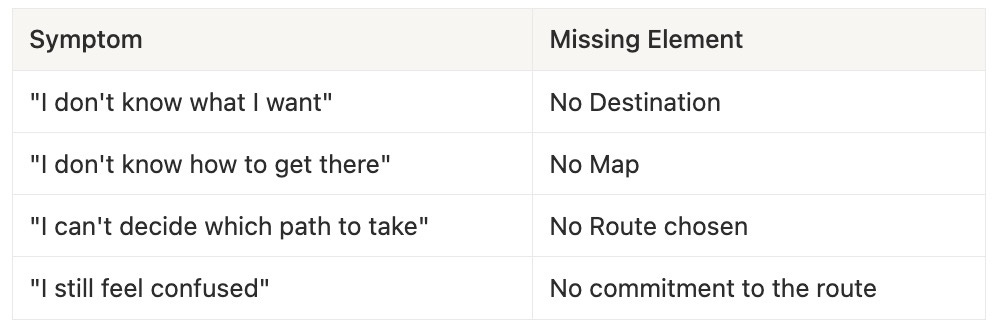
The solution is always the same: identify the missing element and address it directly.
How to Apply This
Step 1: Define your destination.
Write it down. Make it specific. Give it a timeframe.
Step 2: Build a minimal map.
Identify 2 to 3 realistic routes to your destination. Don’t over-research. Good enough is good enough.
Step 3: Choose your route and commit.
Pick one route. Set a test period (30 days, 90 days). During that window, no second-guessing. Your only job is execution.
What happens next: The fog lifts. Clarity emerges. You stop debating “what should I do?” and start solving “how do I do this?”
One Question
You’ve read this entire framework.
You understand the three elements.
You know that commitment creates clarity.
So here’s the only question that matters:
What route are you going to commit to, and when does your test plan start?
Not “which route is best.”
Not “what if it doesn’t work.”
Not “let me think about it.”
Just: what route, and when.
If you can’t answer that question right now, you’re missing one of the three elements.
Go back and identify which one.
If you can answer it, write it down.
Set the start date.
Then stop reading and start building.
Clarity is waiting on the other side of your commitment.
Not a paid member yet?
Upgrade now and unlock the Premium Vault.
Get instant access to systems, prompts, challenges, frameworks, AI tools, and resources worth thousands.
See the full benefits of becoming a paid subscriber below.
Your future self will thank you.


Clarity breeds mastery.
The goals you set drive the actions you'll take.
- Robin Sharma.
Interesting Substack Posts I Read This Week:
Behind the First Digital Dollar with Taylin John Simmonds: From $30K Debt to $3K/Month by Taylin John Simmonds
The Most Important Post in Your Substack: Your “Hero Post” by Veronica Llorca-Smith
Four Simple Questions To Create Your Profitable One-Person Business Niche by Michael Lim
The Complete Vibecoding & Speccoding Resource Hub by Karo (Product with Attitude)
Design Your Vision: Why vision is the starting point for aligning your business-of-one and scaling beyond money by Nick Bennett , Erica Schneider and Katrina Kirsch
Grok by Ruben Hassid
Stop Re-Explaining Yourself to AI (Save 50+ Hours) by Sharyph
Thanks for reading! Ready for the next step?
Let’s crack the growth equation and build a thriving one-person business on your terms!
Anfernee
Do you think that occasionally anger can create clarity?