
How Email Functions as a Mini-Funnel: A Step-by-Step Guide to Converting Subscribers
Learn how every email can act as a mini-funnel guiding subscribers from curiosity to conversion.

Access your FREE Solopreneur Success Hub - your subscribers-only comprehensive command center for building and scaling a successful one-person business.
I created this all-in-one toolkit for building a profitable one-person business, something I wish existed when I first started, and it saves me 20+ hours a week.
Now, it’s yours… FREE!
More information about the Hub here.
As a prelude to the context of this post, this was what I posted earlier:
I kind of think that every email you send is secretly a mini-funnel.
Hear me out…
The purpose of a sales funnel is to guide potential customers through a structured journey from initial awareness to a final purchase, ultimately increasing conversion rates and revenue.
Coincidentally, emails are also about guiding subscribers from curiosity to conversion.
So I believe when each piece of an email is intentionally crafted, your emails will naturally drive more opens, clicks, and sales.
Here’s the full roadmap.
If you’ve ever hit “send” on an email campaign and crossed your fingers, hoping subscribers would open… click… and maybe… just maybe… buy… then you’re about to breathe a huge sigh of relief.
Because the truth is, email already has a built-in funnel structure.
A really effective one, at that.
Once you understand how each element works together, from the subject line to the post-purchase experience, your emails stop feeling like random shots in the dark and start functioning like intentional, predictable mini-funnels.
And the best part?
You don’t need to explicitly tell readers why they should care, why they should listen, or why they should click.
When your content is consistently valuable, those answers become self-evident.
Let’s break this down, step by step, so you can turn every single email into a smooth, irresistible funnel that nudges subscribers all the way to the checkout page (and beyond).
What Is an Email Mini-Funnel, Anyway?
Traditional funnels move people step-by-step from awareness → interest → desire → action.
Email does the exact same thing.
Just in a condensed, bite-sized format.
Each email contains:
Top of funnel: Subject line
Curiosity amplifier: Headline or byline
Value & connection: Body content
Action prompt: Call to action
Conversion destination: Sales page, subscription form, call booking page
Monetization: Purchase
Retention: Post-purchase nurturing
One message.
One micro-journey.
One opportunity to build the relationship and guide behavior.
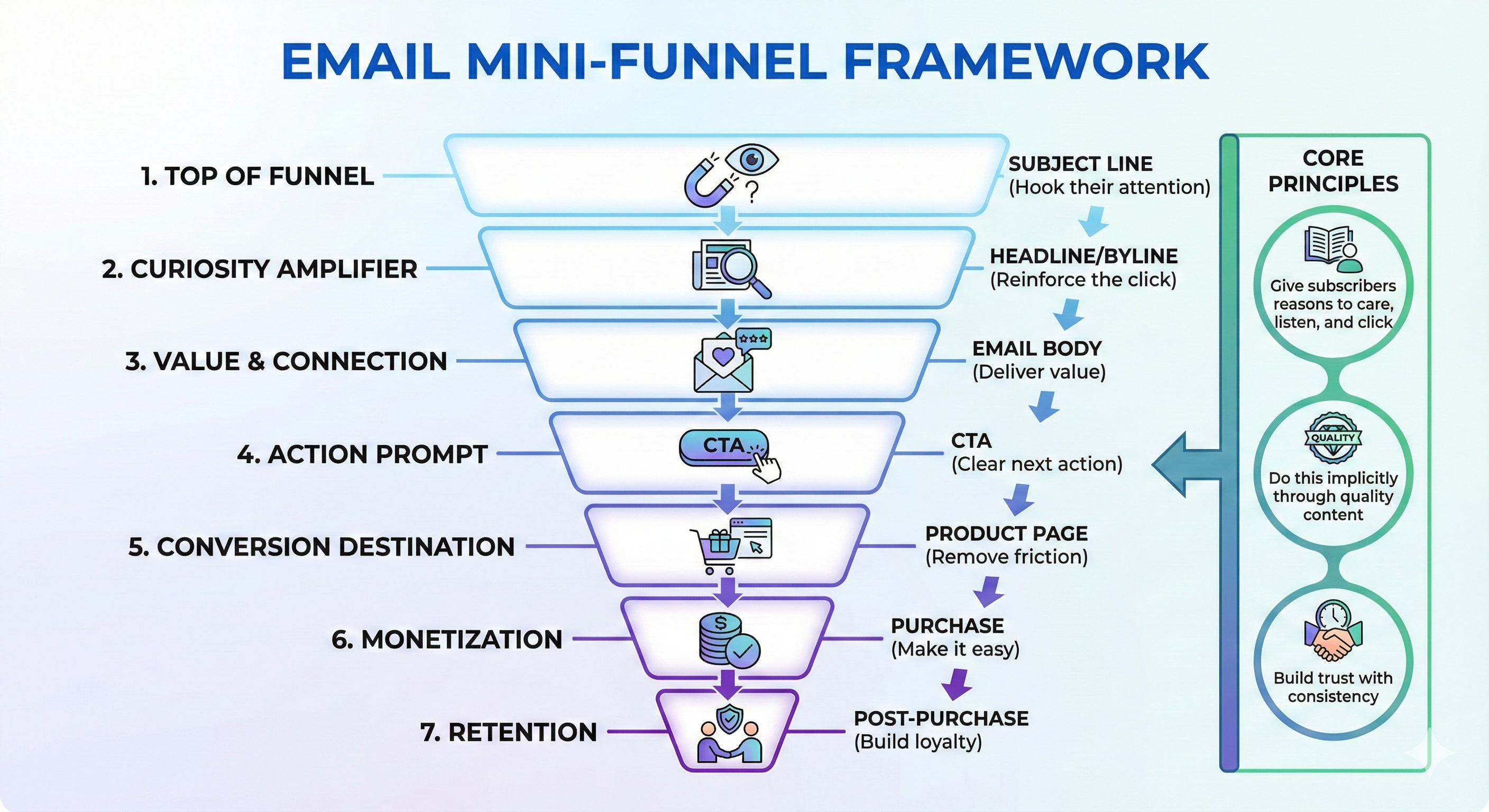
Once you structure your emails with this framework, you’ll find engagement rises naturally because readers always know why they should stick around even if you never spell it out.
Now let’s unpack each stage.
1. Subject Line - The Top of the Funnel
The subject line is where everything begins.
Your equivalent of top-of-funnel traffic.
It has one job:
Make the recipient open the email.
If the subject line doesn’t do its thing, nothing else in your email matters.
But here’s the nuance:
You don’t want to be clickbaity, manipulative, or overly mysterious.
The goal is earned curiosity, not cheap tricks.
Elements of strong subject lines:
A tiny tease of value
A hint of relevance
A quick emotional trigger
Natural, human-sounding language
Examples
“The tiny mistake that’s killing your conversions”
“A 2-minute tweak that boosts email clicks instantly”
“If your emails feel ignored, read this”
The subject line sets expectations and primes the reader for what’s coming next.
And when it’s consistently aligned with the content that follows, your open rates will grow steadily.
2. Headline / Byline - The “Hmm, Tell Me More…” Moment
Before they open or once they open the email, readers take about two seconds to decide whether to continue.
That’s where your headline or byline comes in.
Think of it as a mini landing-page header:
Something short, punchy, and clarifying that pulls the reader in.
Its job?
To make the reader think:
“Okay, I’m definitely reading this.”
Examples
“Here’s the real reason your email list isn’t buying”
“One shift that instantly improves your funnel”
“A lesson nobody tells new email creators”
Your headline continues the curiosity journey by grounding your message in value they care about.
3. The Email Body - Where Trust Is Built Quietly
This is where you deliver the goods.
Not “inspirational” vagueness.
Not long-winded paragraphs that go nowhere.
Your body content must do three quiet things at once:
Make them care by giving them something they can use right away—an idea, a perspective, a fix—something that makes them think, “Oh, this actually helps.”
Make them listen by showing up with real value. Just insights that make their work easier and their results better.
Make them click by connecting the dots between the problem they’re feeling and the solution waiting on the other side so the click feels like the obvious next step.
You want your email body to feel like a friend texting valuable advice.
Warm.
Helpful.
Straightforward.
Real.
This is also where your personality does the heavy lifting.
The more human, grounded, conversational, and consistent you sound, the more subscribers lean in.
Elements of a strong body section:
Short paragraphs
Relatable examples
Clear insights
Value-first explanation
Seamless lead into the CTA
When the body content hits, clicking the CTA feels like a natural next step and not a pressured one.
4. The CTA - The Turning Point of the Mini-Funnel
Your call-to-action is the micro-conversion moment.
Now here’s the nuance many email writers miss:
A CTA isn’t about shouting “CLICK HERE!”
It’s about continuing the conversation but in a different location (your sales page, booking page, etc.).
Your CTA should feel like the logical next step in the story you just told.
CTA examples with subtlety:
“Here’s where you can see how it works.”
“If this is the shift you’ve been needing, you’ll want to check this out.”
“This breaks everything down more clearly.”
Notice how these CTAs are not aggressive?
They’re more like invitations.
The click should feel like progress for the reader.
5. The Sales Page - Where Desire Meets Decision
Once readers click, they land on your:
sales page
subscription page
booking page
product page
This is where the mini-funnel hands off to the most important portion of the funnel.
Your sales page is where curiosity turns into clarity and clarity turns into buying behavior.
And because your email prepped them subtly, your page doesn’t have to work as hard.
They arrive warmed up, aware, and interested.
When your email funnel is solid, your conversion rate jumps because your traffic arrives believing you might already be the solution.
6. The Purchase - The Bottom of the Mini-Funnel
If they buy, congrats! You’ve guided them from:
subject line → decision → purchase
all within a single, well-crafted, value-based email.
But here’s the thing:
Purchases aren’t the end of the funnel only.
Rather, they’re an entry point into the next one.
Which brings us to the last stage…
7. Post-Purchase - Where True Lifetime Value Is Built
Here’s where most email creators drop the ball.
After a sale, the relationship should deepen.
Your post-purchase experience can include:
onboarding emails
bonus value
success tips
follow-up stories
future upsell pathways
retention content
This builds customer loyalty without forcing it.
Because the truth is:
People buy because they trust you.
They stay because you keep proving they were right to trust you.
Your post-purchase emails are your chance to reinforce that feeling.
Why Subtlety Is Your Superpower
The biggest mistake email creators make is explicitly trying to convince subscribers:
“You should care because…”
“You should listen because…”
“You should click because…”
That approach feels forced.
It feels needy.
It feels… salesy.
Instead, your content done right will speak for itself.
Readers sense the value.
They feel the alignment.
They trust your voice.
They care, they listen, and they click because everything you send earns their attention.
Consistent value is the quiet engine of conversion.
How to Deliver Consistent Quality Emails (Without Burning Out)
Let’s get tactical.
Here are simple habits to keep your emails strong, trustworthy, and click-worthy:
Write daily, even if you don’t send daily
This keeps your tone sharp and your thinking clear.
Keep paragraphs short and punchy
Modern readers scan, not stare.
Use simple language
Clarity converts more than cleverness.
Anchor every email in one takeaway
Don’t overwhelm readers. Guide them.
Plant curiosity early
Your first 2–3 lines matter more than you think.
Make the CTA feel like the next step, not a sales pitch
Readers should want to click, not feel pressured to.
Maintain a consistent personality
Trust is built through familiarity.
Treat your emails like conversations, not campaigns
Your subscribers should feel spoken to, not marketed at.
Examples of Great Email Mini-Funnel Flows
Here are actionable templates showing how each component works together.
Example 1: Story-Driven Funnel
Subject: I almost quit writing emails last year
Headline: Here’s why that turned out to be good
Body:
Tell a short, honest story, explain the lesson, teach the takeaway, and show how the solution can help readers.
CTA:
“This is what helped me get back on track, thought you might want to see it.”
Example 2: Problem–Solution Funnel
Subject: Your funnel might be leaking here
Headline: A small gap with big consequences
Body:
Describe a pain point, validate the reader’s experience, introduce a simple mental shift or framework, and preview the bigger solution.
CTA:
“I break the whole thing down here if you’re curious.”
Final Thoughts
When you understand that every email is a mini-funnel, everything gets easier:
Your writing becomes more intentional.
Your subscribers become more attentive.
Your clicks become more consistent.
Your conversions rise quietly in the background.
This isn’t about hype.
It’s about structure.
It’s about consistency.
It’s about making your emails feel like progress for your readers—not pressure.
And once you master this, your entire email strategy becomes smoother, more strategic, and wildly more profitable.
Onto The Next Level!
Great! You now have everything you need to craft high value, high converting emails.
But if you want to turn this into a repeatable system, I’ve created three advanced AI prompts that help you design, audit, and optimize every email funnel you send.
They’re available to paid subscribers.
Not a paid member yet?
Upgrade to paid access now to unlock the Premium Vault, join monthly live trainings, and get access to the AI Toolbox and Action Lab.
Want to read more about the FULL benefits of being a Paid Subscriber?
🚀 Your future self will thank you.


Paid Subscriber Bonus: 3 Premium AI Prompts
1. Email Funnel Architect Prompt
Create a full email mini-funnel blueprint—from subject line to CTA—based on the user’s product, audience, and goal.
Here’s an example for this amazing prompt:
I used these as inputs.
TOPIC: “Why email is the most underrated mini-funnel for solopreneurs”
AUDIENCE: “Solopreneurs with a small but warm list (under 2,000 subs)”
And here’s the output:
2. Email Audit Prompt
Analyze any email for clarity, flow, voice, persuasion, CTA strength, and funnel alignment. Provide edits and rewrite options.
3. Subject Line + CTA Generator
Generate 20+ subject lines and 15+ CTAs based on tone, intent, and audience psychology.