
How I Made My First Digital Dollar and Why It Meant More Than the Money [Xinran Ma]
A story about self-publishing, perfectionism, and shipping before you're ready

Welcome to the First Digital Dollar Project
Every week, a solopreneur shares the honest story of how they earned their first dollar online. They also join me on Substack Live to dive deeper into their journey.
Each story follows one path from idea to struggle to income. You will see the doubts they faced, the pivots they made, and the exact steps that led to that first sale.
Whether you are still searching for your breakthrough or already building momentum, these stories show you what is possible when you take action.
This post is a guest contribution from Xinran Ma , a fellow solopreneur sharing the story of that first sale.
More on the project and the list of contributors:

I still remember refreshing the Amazon sales dashboard more than twenty times a day.
It was July 2023. I had just published my first book. It was a practical guide for people who want to switch careers into product design with limited time. I knew that struggle intimately: I was a mid-career architect who really wanted to change my life, while having a newborn and a busy full-time job.
And now the book was out in the world, and I couldn’t stop tracking how it performs.
Then the first sale came through. It felt surreal.
Then another. Then another. Within days, the book hit #1 new release in multiple categories on Amazon and #2 best sellers in the UX category.
I was exhausted. I had too much mental load at that time with pressure and fatigue. But I was also exhilarated. For the first time, I knew I could make money on my own terms, from something I had built myself.
That first dollar hit me in a way that was completely out of proportion to its actual size. Enormously fulfilling. Like something had permanently shifted.
It was also special because it had taken me at least three years of planning, learning, and waiting to get there.
Here’s the full story.
The Why
2018 to 2020 is a special period of time for me because I wasn’t happy with where I was both career wise and financially.
I often felt like I was behind in life and I had this growing desire to change my life.
But I had to tackle one thing at a time, and I knew changing careers should be the first step.
I had studied and practiced architecture for years. I held two degrees in architecture and was just one exam away from earning my architect’s license. During the day, I was a dedicated employee, but no one knew how badly I wanted a change. Part of that was a desire for a different lifestyle. Another part was the hope of earning more to support my family. I wanted to be a better dad and husband.
When my desire was strong enough, I finally decided to change my career no matter how hard it was. I worked really hard. I squeezed in all the time I could outside of the full-time job, overcame a lot of self-doubt, failed countless job interviews, and eventually made the career transition, landed a full-time job, and doubled my income.
After that, I felt this rush of inspiration. And with it came an impulse to write down everything I’d learned.
I started writing things down on paper.
That was also a time when, having made the career move I wanted, I had more time and mental space to plan for more financial improvements.
I was happy about my new career, and I was also fascinated by all kinds of inspiring people sharing their journeys on Twitter. I absorbed what they were doing like a sponge. I also read a lot of business books at that time. I felt like discovering a whole new world.
Then I began to think that my learnings with career transition could one day become a book and that sounds like a tangible way of making side income online.
The obstacles
The path from “notes on paper” to “published book” actually took years.
The first obstacle was visa. As a foreigner working in the US on a work visa at the time, I could not earn income outside of my full-time job. So I shelved the book draft for years.
The desire was there, but the constraint was real.
I knew I had to wait a long time to make my first digital dollar online until I got my green card.
So I kept learning copywriting, marketing, and self-publishing, with the idea that one day I could apply what I learned once I was able to earn side income.
Then, at the end of 2022, I saw hope in my visa timeline, so I took out my notes scribbled on paper from the bookshelf and found time in the early mornings and on weekends to start writing my book draft in Google Doc, although my full-time job kept me busy.
I was very motivated to write my book almost every day, but a new set of challenges showed up.
English is not my first language. And I was writing without AI tools. This was even before ChatGPT became a thing. So every sentence involved checking dictionaries, cross-referencing phrases, making sure the grammar was clean and the ideas came through clearly. I worried that my writing wasn’t clear enough, so I crafted every sentence carefully because once it was published, it couldn’t be changed. Looking back, had I been a native speaker, I could have saved a ton of time and effort putting together my first book.
And then there was the sheer scope of what “publishing a book” actually involves. It’s not just writing. It’s editing, formatting, designing the cover, writing a compelling description, choosing a title and subtitle that would surface in search, finding a proof editor, planning a book launch campaign, deciding on pricing strategy, figuring out whether to go Kindle only or add a paperback edition.
I learned all of it from scratch, reading articles and tips from other indie authors online. Now that I think about it, AI could have cut that learning curve significantly. But at the time, I was on my own.
There was real pressure, because I’d set a hard deadline for myself: I wanted to publish before an upcoming work trip.
What happened next
After the book launch, and I’ve got good results, I felt tired and relieved. It was such an effort.
But a lot of the tiredness was self-imposed. For example, I cared too much about how my work would be received online, about social perception, and about what my full-time coworkers might think of me.
I was also working hard at my full-time job because I didn’t want to draw attention to my book, even though it was related to my profession. I wanted to keep my full-time job and my side hustle separate. Still, I feared peer pressure, which was self-imposed again.
Anyway, after the first book. I continued.
Actually, before I published my first book, I already had an idea for my second. I knew then, just like with shipping products, that I had to embrace randomness and couldn’t rely on a single book to succeed. In fact, I think I even designed the cover for my second book before the first one was published.
So the next year, I published my second book. Then the third.
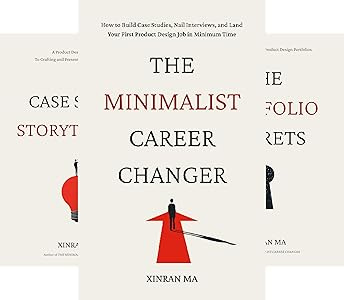
The second book took about half the time of the first. The third took half the time of the second. The process became familiar, and less challenging.
For every book, I treat it as an experiment. For example, my third book included many images and had more pages than others, while my second book focused on a specific theory of mine with examples.
Interestingly, the second book outsold both the others and is still the best selling book of mine. There’s a randomness to these things that no amount of thinking and planning fully accounts for.
Regardless, those books gave me something more valuable than their combined revenue. They gave me end-to-end experience with a digital product—building it, positioning it, launching it, iterating on what I’d learned.
What I learned led directly to writing a newsletter on Substack and eventually creating online courses, both of which eventually generated significantly more income than the books. But none of that happens without the first book and the first dollar.
The first dollar unlocks everything after it.
What I’d tell someone starting today
Desire is powerful.
I’ve written about the importance of desire on social media, and sometimes I receive comments saying that taking action is more important, which I agree with. However, for someone like me, who tends to overthink and worry, desire is incredibly important. When my desire wasn’t strong enough, I procrastinated and doubted myself, just like how I did with my career change as an architect. But when my desire was strong enough, I took the plunge without looking back and I was able to figure out ways to achieve the goal.
Don’t let perfectionism stall you.
This is a big one for me too. Perfectionism doesn’t just slow you down at the execution stage; it prevents you from starting at all. Worse yet, it drains your energy in ways that aren’t sustainable. A certain level of perfectionism helps set a high standard for quality, but there is a delicate balance to strike.
Bias toward action.
This is important for those of you who tend to worry about failing and what other people will think. The act of shipping something and the mindset of embracing randomness overcome that. I would not have written the second or third book if I hadn’t shipped the first one. That’s why making your first dollar is so important—you get to experience the full loop, however small and imperfect, of creating a product, marketing it, and closing the sale.
Love yourself.
That means accepting yourself, taking care of yourself, and believing in yourself. For example, when you are burned out, allow yourself to take a rest. We often treat rest as a way to recover from busy work, but I’ve realized it should be the reverse. Rest should be the foundation of work. If you drain yourself too much by grinding and worrying about what people think of you, it is not sustainable. Another example: when you are doubting yourself, give yourself some love and trust. In this world, when you believe in yourself unconditionally, a lot of challenges are no longer challenges.
— Xinran
The Vision of First Digital Dollar Project
By the end of 6 months, we’ll have created more than content.
We’ll have built proof that there are infinite ways to start.
That your background doesn’t determine your future.
That the first dollar is possible for anyone willing to ship, learn, and iterate.
Your story matters.
Your first dollar was a turning point.
Let’s celebrate it together.
More on the project and the list of contributors:
Find out how 20 solopreneurs with different products, different offers, different strategies, different paths earn their first digital dollars.
"Perfectionism doesn’t just slow you down at the execution stage; it prevents you from starting at all." - 💯Progress matters more than perfection.