
Best Ways Solopreneurs Use Substack Live in 2026
20+ proven Substack Live formats solopreneurs use to build authority, grow subscribers, and turn one session into a content engine. Full playbook inside.

Access your FREE Solopreneur Success Hub - your subscribers-only comprehensive command center for building and scaling a successful one-person business.
I created this all-in-one toolkit for building a profitable one-person business, something I wish existed when I first started, and it saves me 20+ hours a week.
Now, it’s yours… FREE!
More information about the Hub here.
Substack Live is the most underused growth tool in a solopreneur’s stack.
Most creators treat it like a webinar. They hop on, talk for an hour, and hope someone subscribes. That’s leaving authority, community, and content on the table.
I’ve been joining every Substack Live I can find. Not just as a host. As a viewer. I watch the viewership numbers climb and drop. I read the chat responses. I pay attention to which formats hold attention and which ones lose the room in the first five minutes. And now, with Substack’s latest addition of screen sharing, the possibilities for solopreneurs have expanded dramatically.
I have also been doing Substack Live consistently due to the First Digital Dollar Project, so yeah I do know a little about Substack Live
New to Substack Live? Here's the official getting started guide.
This isn’t theory.
This is my personal take on how we can leverage Substack Live based on what I’ve seen work in real time.
The smartest solopreneurs are turning Substack Live into a multi-format engine that builds trust, drives subscriber growth, and produces weeks of repurposable content from a single session.
Here are 20+ ways to do it, organized into six strategic pillars you can start using this week.
1. Authority and Teaching: You as the Expert
This is the foundation. Before people buy from you, they need to trust your thinking.
Substack Live gives you a stage to prove it in real time.
Talking-Head Formats (No Screen Share)
Expert Office Hours / AMA. Run a recurring “Ask Me Anything” session focused on your niche. For solopreneurs, that could be pricing, offer design, systems, or audience growth. You answer live questions, test new ideas, and hear the exact language your audience uses. That language becomes fuel for future content.
Story and Philosophy Shows. Short monologue-plus-chat episodes where you unpack one big idea. Think: the 80/20 rule applied to content, why anti-hustle beats grind culture, or how to design an offer that sells while you sleep. Share the idea, then open up for 3–5 questions. These sessions position you as a thinker, not just a doer.
Screen-Share Formats
Framework Deep Dives. Pull up a simple slide, whiteboard, or Notion page and walk through one of your core frameworks. Show the model. Explain each step. Give examples. The replay becomes a mini-course your subscribers can return to and share.
Live Build-in-Public. Design a system, schedule, or offer flow on screen while narrating every decision. Your audience doesn’t just see the output. They see your thinking. That’s what builds real trust.
Why This Works
Authority isn’t claimed.
It’s demonstrated.
Substack Live lets you do that in real time, with no editing, no filters, and no production budget.
2. Implementation: “Do It With Me” Sessions
Information alone doesn’t change behavior.
Implementation does.
These formats help your audience take action alongside you.
Talking-Head Format
Action Hour Check-Ins. Pomodoro-style sprints. Set one goal at the top. Do 20-25 minutes of focused work (cameras on or off). Regroup for 5 minutes of debrief and next steps. Simple format. High accountability. Subscribers love it because it makes them do the thing.
Screen-Share Formats
Implementation Sprints (Great for Paid Tiers). “Build your lead magnet in 45 minutes.” “Set up your weekly review system.” Share your screen, walk through a template, and let viewers follow along step by step. This is one of the highest-value Substack Live formats and a strong reason for people to upgrade to a paid subscription.
Systems Walkthroughs. Show how you actually track content, leads, or revenue inside your own stack. Let subscribers see the real system, not a polished screenshot. Give them the option to copy or adapt your setup.
Why This Works
People don’t just want to learn.
They want to finish something.
These sessions give them a container to do that with guidance.
3. Teardowns, Coaching, and Hot Seats
Nothing proves expertise faster than solving someone’s real problem in real time.
These formats create massive perceived value and they make incredible replay content.
Talking-Head Format
Hot Seat Coaching. Bring 1 to 2 subscribers on as guests. Coach them live on positioning, pricing, or strategy. The focus is on conversation and decision-making. The audience learns by watching you think through someone else’s challenge.
Screen-Share Formats
Offer and Landing Page Teardown Lab. Pull up a volunteer’s page on screen. Mark up the copy, structure, and calls to action in real time. Explain what’s working and what’s not. This is high-value, high-engagement content and it’s incredibly shareable as a replay.
Funnel and Workflow Audits. Map someone’s funnel on a mind map or whiteboard. Identify the gaps. Show a simpler alternative. Subscribers walk away with a clear picture of what to fix and proof that you know how to fix it.
Why This Works
Teardowns and hot seats are spectator sports.
Even people who don’t volunteer learn by watching.
And the subscriber whose page you review?
They become a loyal fan for life.
4. Community and Relationship Building
Growth isn’t just about reach. It’s about depth.
These formats turn subscribers into a community and a community into a growth engine.
Talking-Head Formats
Community Standups. Weekly or monthly check-ins where attendees share wins, blocks, and one intention for the week. You facilitate, reflect patterns, and keep it under 30 minutes. This creates rhythm, accountability, and a sense of belonging that no static newsletter can match.
Behind-the-Scenes Chats. Casual sessions: “What I’m experimenting with this month.” “What failed last week.” “What I’m thinking about for Q3.” These make your business feel human. They give subscribers early access to your thinking. And they build the kind of trust that converts free readers to paid.
Light Screen-Share Format
Show and Tell Board. Occasionally pull up your content calendar, pipeline, or experiment log to ground the conversation in something visual. This keeps the session tangible while staying discussion-driven.
Why This Works
Substack Live’s real-time interaction layer creates emotional stickiness.
People remember how a community made them feel far more than what a blog post said.
5. Growth, Launch, and Collaboration
Substack Live isn’t just a retention tool.
It’s a growth tool, especially when you collaborate with other creators.
Talking-Head Formats
Launch Q&A and Announcement Lives. Use a live session to kick off or close a launch. Introduce a new offer, cohort, or paid tier. Walk through FAQs. Handle objections in real time. This is warmer and more persuasive than any sales page.
Co-Hosted Interviews and Panels. Invite an adjacent creator to talk through a shared topic. You pool audiences. Viewers from both sides subscribe. The live session itself (plus the replay post) becomes a subscriber acquisition event.
Screen-Share Formats
Joint Teardown or Critique Shows. Co-host with another creator and screen-share assets from both audiences, newsletters, sites, hooks. Give rapid-fire feedback. This is entertaining, educational, and highly shareable.
Live Case Studies. Walk through actual results. Show annonymized dashboards, before-and-after pages, or real metrics. Explain what changed and why. This doubles as social proof and teaching content.
Why This Works
Collaboration multiplies your reach without ad spend.
And launch lives convert better than static emails because objections get handled on the spot.
6. The Content Engine: Repurposing Every Session
Here’s where Substack Live becomes a true force multiplier.
One session can fuel your content for weeks.
Use clear, specific titles. Make every session searchable and feed-friendly. “Live Teardown: 3 Solopreneur Landing Pages in 30 Minutes” beats “Let’s Chat” every time.
Turn lives into assets. Let Substack publish the replay as a post. Add a tight summary and key links. Then clip highlights for Notes, YouTube, LinkedIn, and X. One live session becomes 5–10 pieces of content.
Create recurring “shows.” Name your best formats. “Solopreneur Lab Live.” “OS Office Hours.” “The Teardown.” Give them a fixed cadence, i.e. weekly, biweekly, monthly. Recurring shows become part of your brand, not random events. Subscribers know when to show up.
Why This Works
The solopreneurs winning on Substack aren’t creating more content.
They’re extracting more value from the content they already create. Substack Live is the starting point for that entire pipeline.
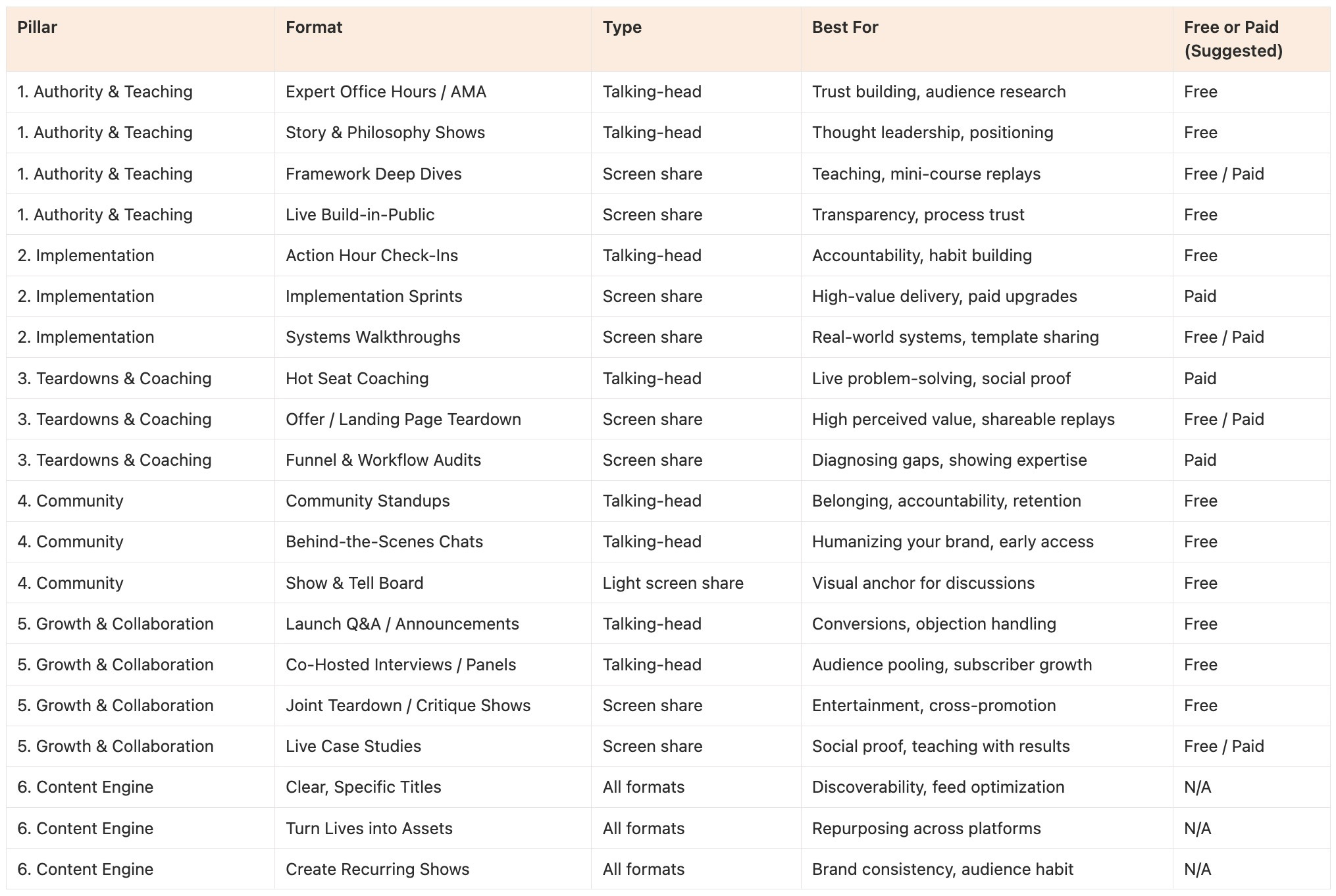
Quick Reference: All 20+ Substack Live Formats at a Glance
How to Get Started (Your First Substack Live in 7 Days)
You don’t need to master all six pillars at once.
Start with one format and build from there.
Pick one pillar that matches your current strength. If you’re a natural teacher, start with Authority. If you love community, start with Standups.
Choose a format and give it a name. Even a working title helps it feel real.
Set a date within 7 days. Announce it to your subscribers. Keep the first session short, around 30 minutes max. I’m personally not too sure if we should email to subscribers. Let me know if you have a thought on this in the comments.
Record and repurpose. After the session, publish the replay, write a summary, and clip one highlight for social.
Repeat. Consistency beats perfection. Your fifth session will be 10x better than your first.
Frequently Asked Questions
Do I need a large subscriber count to make Substack Live worthwhile?
No. Some of the best sessions happen with 5-15 people. Small audiences mean deeper conversations, better feedback, and stronger relationships. Start where you are.
I personally had sessions with as little as 15 people to 345 people.
The most important thing is to just do it.
Should I gate Substack Live sessions behind a paid subscription?
Mix it up. Use free sessions for authority and growth (AMAs, panels, behind-the-scenes). Reserve high-value implementation sprints and teardowns for paid subscribers. This creates a natural upgrade path.
How long should a Substack Live session be?
30-45 minutes is the sweet spot for most formats. Community standups can be shorter (20 minutes). Deep dives and implementation sprints can run up to 60 minutes. Respect your audience’s time.
I personally stick to 45min to an hour.
What equipment do I need?
A laptop with a decent webcam and microphone. That’s it. Substack Live runs in the browser. Good lighting and a quiet room matter more than expensive equipment.
How do I promote a Substack Live session?
Announce it via a Substack post and Notes at least 1 day before. Remind subscribers the morning of. After the session, publish the replay with a summary. Each session promotes the next one.
I’m not too sure about sending out the reminder via email is good or bad. Let me know in the comments if you have any experience trying out both.
Final Thoughts: Substack Live Is Your Unfair Advantage
Most solopreneurs are still stuck in the “write and hope” cycle.
Publish a post. Wait for subscribers. Repeat.
Substack Live breaks that cycle. It lets you build authority, create community, launch offers, collaborate with peers, and generate weeks of content, all from a single session.
The playbook is here. The platform is free. The only thing left is to go live.
Feel free to DM me if you want to go Live with me :)

Follow Solopreneur Code for more frameworks, systems, and strategies to grow your one-person business.
Btw, I spent $5,998 so you don’t have to.
I spent $5,998 on Hormozi’s full Money Models bundle.
All the books, playbooks, and workshops.
Then I turned it into a tool my paid subscribers can use to stress-test their offers, pricing, and business models before they build them.
It’s called The $100M Brain.
If you want to run your money model through Hormozi-style logic before you launch, access this special tool here:

Not a paid member yet?
Upgrade now and unlock the Premium Vault.
Get instant access to systems, prompts, challenges, frameworks, AI tools, and resources worth thousands.
See the full benefits of becoming a paid subscriber below.
Your future self will thank you.


“No one has ever become poor from giving.”
- Anne Frank
Thanks for reading! Ready for the next step?
Let’s crack the growth equation and build a thriving one-person business on your terms!
Anfernee
Thank you for this, Anfernee.
Since having my first Substack live I’ve been thinking that it could be a great opportunity to show up in so many ways other than just a talk. Screen sharing is a good idea although it threw me off with going back to the audience. Your article is a great resource for any of us trying to take advantage of the system capabilities and in addition to my thinking, your examples are very useful and creative.
Thank you for this information with us. Timo mentioned you in his substack post