
The 4 Money-Making Models Every Solopreneur Should Know
Most solopreneurs have one offer and wonder why cash flow is tight. The problem isn't the offer. It's the model. Here are the 4 you need.

Access your FREE Solopreneur Success Hub - your subscribers-only comprehensive command center for building and scaling a successful one-person business.
I created this all-in-one toolkit for building a profitable one-person business, something I wish existed when I first started, and it saves me 20+ hours a week.
Now, it’s yours… FREE!
More information about the Hub here.
Most solopreneurs struggle with cash flow because they have one offer instead of a money model.
A money model is a sequence of four offer types stacked in order:
Attraction → Upsell/Downsell → Continuity.
The goal is to make each customer worth more than the cost (time/money/effort) to acquire them.
This framework comes from Alex Hormozi’s $100M Money Models book, but I’ve contextualised it for solopreneurs like you.
And I spent $5,998 so you don’t have to. Now you can access my $100M Brain too.
Enjoy.
Most solopreneurs have one offer. Maybe two.
They wonder why cash flow is always tight.
Why every month feels like starting over.
Why growth feels so slow even when they’re working harder than ever.
Here’s the uncomfortable truth: the problem is not your offer. It’s your model.
I learned this from Alex Hormozi’s book $100M Money Models.
It changed how I think about building a solopreneur business.
And in this post, I’m going to break down the core framework so you can apply it to your own business without reading 190 pages or spending $6,000 on a workshop.
Let’s get into it.
What Is a Money Model?
Before we talk about the four types, let’s define our terms.
An offer is one thing you sell in exchange for money. A course. A coaching package. A template. A membership.
A money model is different. It’s the sequence of offers you line up across the customer journey, so that new customers quickly become highly profitable customers.
Here’s why this matters:
Most solopreneurs sell one offer at a time.
Someone buys, you deliver, and then you start looking for the next customer.
It’s exhausting.
And it keeps you stuck in a cycle where growth depends entirely on how many new people you can find.
A money model flips this.
Instead of chasing new customers constantly, you design a system where each customer generates more revenue over time, through upsells, downsells, and recurring offers.
The goal of a $100M Money Model: A new customer pays you more (within 30 days) than you paid (or invested with time and/or effort) to acquire them.
When that happens, cash flow stops being a constraint.
You can reinvest in growth without worrying about runway.
The 4 Offer Types in a Money Model
In $100M Money Models, Hormozi outlines four main offer types that you stack together to build a complete money model.
Each one serves a specific purpose in the customer journey.
1. Attraction Offers
Role: Turn strangers into first-time customers.
Attraction offers are typically low-ticket or heavily discounted.
The goal isn’t to make a profit here, it’s to get someone to say “yes” for the first time.
Once someone has paid you anything, the relationship changes.
They’ve crossed from “audience” to “customer.”
And customers are far more likely to buy again than people who have never bought.
Solopreneur example: A $9 workshop that leads into your main program. A $27 ebook that introduces your methodology. A $47 mini-course that solves one specific problem.
The key is to make this offer so valuable that saying “no” feels like a mistake.
2. Upsell Offers
Role: Get buyers to spend more immediately after buying.
Right after someone purchases, they’re in “buying mode.”
Their wallet is already open.
Their trust is high.
This is the perfect time to offer something more.
Upsells typically offer a better version, a bundle, or a complementary product that enhances the original purchase.
Solopreneur example: “Upgrade to VIP and get live implementation support for $199.” Or: “Add the done-for-you templates for $97.”
The mistake most solopreneurs make is not having an upsell at all.
They leave money on the table with every single transaction.
3. Downsell Offers
Role: Capture revenue from people who say “no” to your main or upsell offer.
Not everyone will say yes to your core offer.
But that doesn’t mean they’re a lost cause.
A downsell gives them a lighter option, something easier to commit to, lower risk, smaller scope.
Solopreneur example: “Can’t do the full course for $497? Get the recordings only for $97.” Or: “Not ready for coaching? Start with the self-paced version for $149.”
Downsells let you monetize “no” answers instead of losing the customer entirely.
4. Continuity Offers
Role: Keep customers paying over time.
This is where the real money is.
Subscriptions, memberships, and repeat-purchase programs create predictable recurring revenue.
They also increase customer lifetime value dramatically.
Solopreneur example: A $49/month community or templates library. A $99/month retainer for ongoing support. A $19/month content subscription.
Continuity offers turn one-time buyers into long-term revenue streams.
They’re what separate solopreneurs who are always hustling from solopreneurs who have stable, growing businesses.
The Money Model Sequence
Here’s how these four offer types work together:
Attraction → Upsell/Downsell → Continuity
You attract a new customer with a low-ticket offer.
Immediately after, you present an upsell to increase order value.
If they decline, you offer a downsell to capture some revenue.
Then you invite them into a continuity offer for recurring revenue.
This sequence is the backbone of any strong money model.
It’s not about having more products, it’s about sequencing the products you have so each customer becomes more valuable over time.
The 3 Stages of a $100M Money Model
Hormozi describes three stages that any strong money model progresses through.
If you’re just starting out, don’t try to build all four offer types at once.
Instead, move through these stages in order.
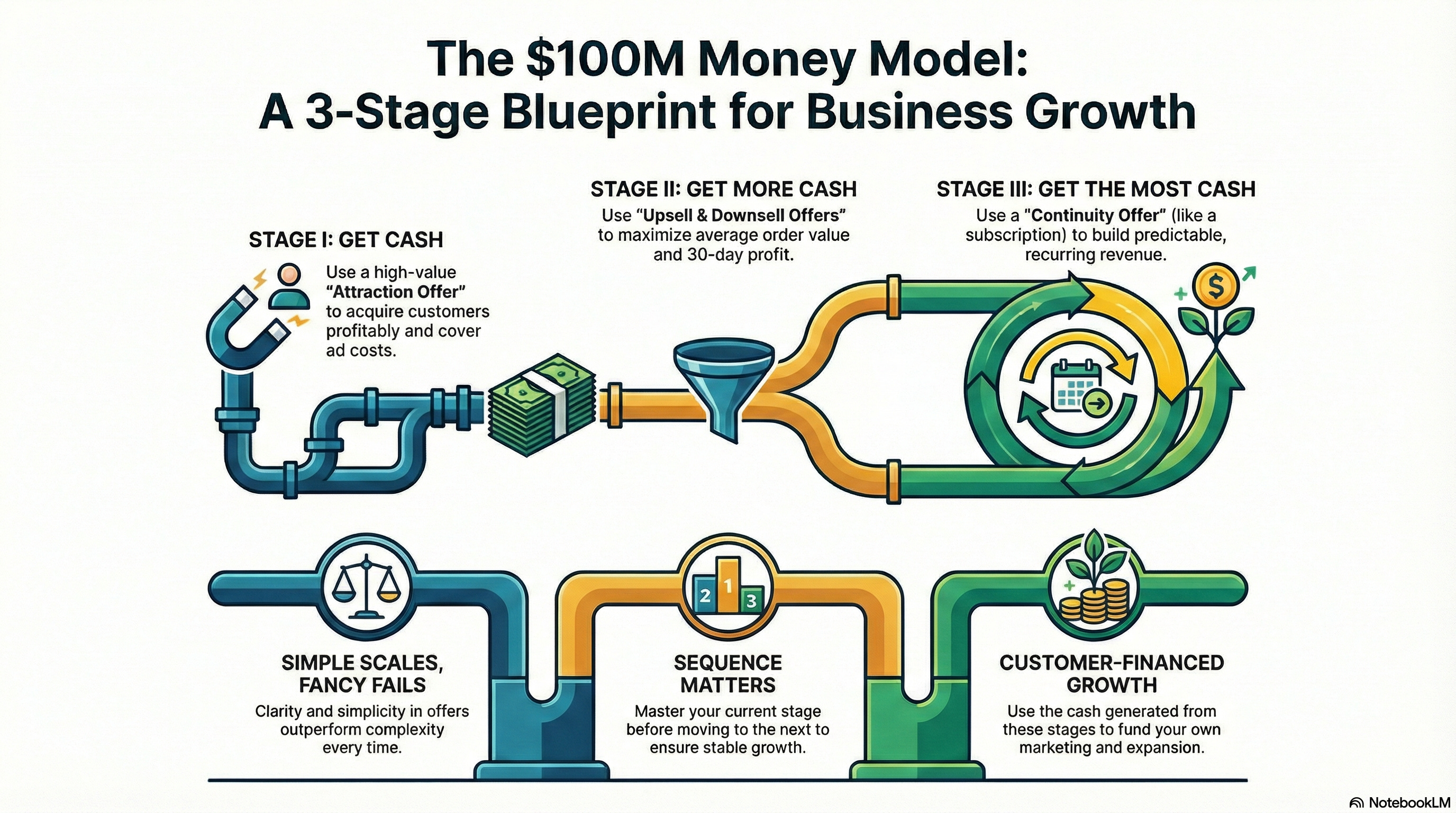
Stage 1: Get Cash (Acquire Customers Cheaper)
Focus on building and refining your attraction offer.
The goal is to acquire customers at a low or even breakeven cost.
At this stage, you’re not trying to maximize profit per customer.
You’re trying to build a reliable, predictable flow of new buyers.
Once you have that, everything else becomes easier.
Key question: What low-ticket offer could you create that would turn strangers into first-time customers?
Stage 2: Get More Cash (Increase Order Value and Speed)
Once you have a working attraction offer, layer in upsells and downsells.
This boosts your average order value and helps you recover acquisition costs faster.
The goal here is to make back your acquisition cost quickly, ideally within 30 days, so you have surplus cash to reinvest in growth.
The acquisition cost mentioned here can be:
Money (ad spending)
Time
Effort
Key question: What could you offer immediately after someone buys your attraction offer that would make the experience better or faster?
Stage 3: Get the Most Cash (Maximize Lifetime Value)
Finally, add continuity offers so customers keep paying over months or years.
This is what makes a business highly stable and sellable.
Recurring revenue is the ultimate leverage.
It compounds over time and gives you predictable cash flow that doesn’t depend on constant launches.
Key question: What could you offer on a subscription or membership basis that would keep customers engaged long-term?
Why This Matters for Solopreneurs
If you’re a solopreneur, you might be thinking: “This sounds like big business stuff. I’m just one person.”
But that’s exactly why money models matter.
As a solopreneur, you have limited time and energy.
You can’t afford to chase new customers forever.
You need a system that extracts more value from each customer relationship without requiring more of your time.
Here’s the shift:
Old way: Create one offer, sell it, look for the next customer, repeat.
New way: Create a sequence of offers that turns one customer into multiple transactions over time.
A simple money model for a solopreneur might look like this:
Free lead magnet (builds trust)
$27 guide (attraction offer)
$297 course (core offer)
$97 templates add-on (upsell)
$49/month community (continuity)
You don’t need all of these to start.
But having even two or three offers in sequence will dramatically change your cash flow and growth potential.
The Biggest Mistake Solopreneurs Make
Most solopreneurs skip the attraction offer and jump straight to high-ticket.
They try to sell a $2,000 coaching package to someone who has never bought anything from them.
And then they wonder why sales feel so hard.
Here’s the truth:
high-ticket sales get easier when you have a sequence leading up to them.
When someone has already bought your $27 guide, then your $297 course, then joined your $49/month community… selling them a $2,000 coaching package becomes a natural next step.
The trust is already there.
The relationship is already built.
Money models aren’t about having more products.
They’re about better sequencing of the products you have.
And Finally
Most solopreneurs are stuck because they’re thinking about offers, not models.
They’re focused on creating the perfect product when what they really need is a sequence that turns one customer into many transactions over time.
The four offer types (Attraction, Upsell, Downsell, Continuity) aren’t complicated. But they require you to think differently about how you build your business.
Start simple.
Pick one stage.
Build one offer at a time.
And sequence them intentionally.
If you want to go deeper, I spent $5,998 on Hormozi’s full Money Models bundle — all the books, playbooks, and workshops. Then I turned it into a tool my paid subscribers can use to stress-test their offers, pricing, and business models before they build them.
It’s called The $100M Brain.
If you want to run your money model through Hormozi-style logic before you launch, access this special tool here.
Not a paid member yet?
Upgrade now and unlock the Premium Vault.
Get instant access to systems, prompts, challenges, frameworks, AI tools, and resources worth thousands.
See the full benefits of becoming a paid subscriber below.
Your future self will thank you.


"A good money model gets you more customers, to spend more money, in less time, over and over again" - Alex Hormozi
Interesting Substack Posts I Read This Week:
The Hormozi Confession - “I Adopted ‘F*ck Happiness’ as My Mantra” by Phil Powis ❤️⚡️
Neuro-Engineering: how to neutralise the urge to check your phone by Juliette Ryan
AI Was Supposed to Close the Expertise Gap. Here’s What Happened Instead. by Max Bernstein
36 Claude Skills Examples to Transform How You Work (From 23 Creators) by Daria Cupareanu , Kamil Banc , Karo (Product with Attitude) , Jenny Ouyang , Raghav Mehra , Wyndo , Jeff Morhous , Ilia Karelin , Dee McCrorey , Dheeraj Sharma , Jean-Paul Paoli , Jose Antonio Morales , Ed Rodgers , Alex Willen , Mariam Vossough , Nick Quick , Patrick Schaber , Zain Haseeb , Joel Salinas , mark , Jinx and Rhonda Britten
Why Using AI to Create Digital Products Isn’t Cheating (And Why That Belief Is Holding You Back) by Evan - The Nicheless Creator
From 0 to 14,000 Subscribers. Here’s What Actually Worked at Every Stage. by Claudia Faith
What If You Grew More by Doing Less in 2026? by Simply Esther
Here’s a $100K idea people are actually searching for by Noemi Kis
How To Create Your Own Substack Notes Scheduler (or any other tool you need) by Claudia Faith
The Complete Guide to Build Your Personal AI Operating System With Claude Code by Wyndo
Your 30 day plan to blow up on Tiktok in 2026 by Sabrina Ramonov 🍄
How to build your dream life in just 1 hour per day by Tim Denning
Thanks for reading! Ready for the next step?
Let’s crack the growth equation and build a thriving one-person business on your terms!
Anfernee
thanks for linking the hormozi essay. I had a ton of fun with that one! Haven't read this post yet TBH but adding a bookmark to circle back!